Welcome to Elphinstone Reef, one of Egypt’s most iconic dive sites located in the southern Red Sea. Just a short boat ride from Marsa Alam, this world-renowned reef offers dramatic drop-offs, strong currents, and encounters with some of the ocean’s most majestic creatures.
| Feature | Details |
|---|---|
| 📍 Location | ~12 km offshore from Marsa Alam, Egypt |
| 📏 Reef Length | Approx. 300 meters |
| 🌊 Depth Range | 18 to 70+ meters |
| 🦈 Famous For | Oceanic whitetip sharks, hammerheads |
| 🌿 Coral Type | Soft and hard corals |
| ⚠️ Dive Level | Intermediate to Advanced |
| 🕒 Best Time to Dive | March to June & September to November |
| 🚤 Access | Daily boat trips with Deep South Divers |
Features & Topography of Elphinstone Reef
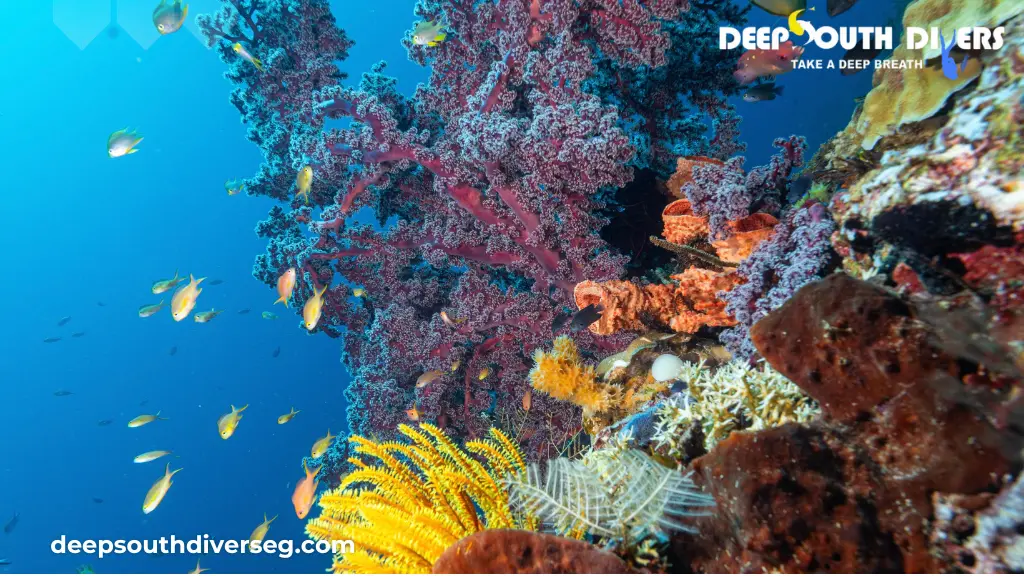
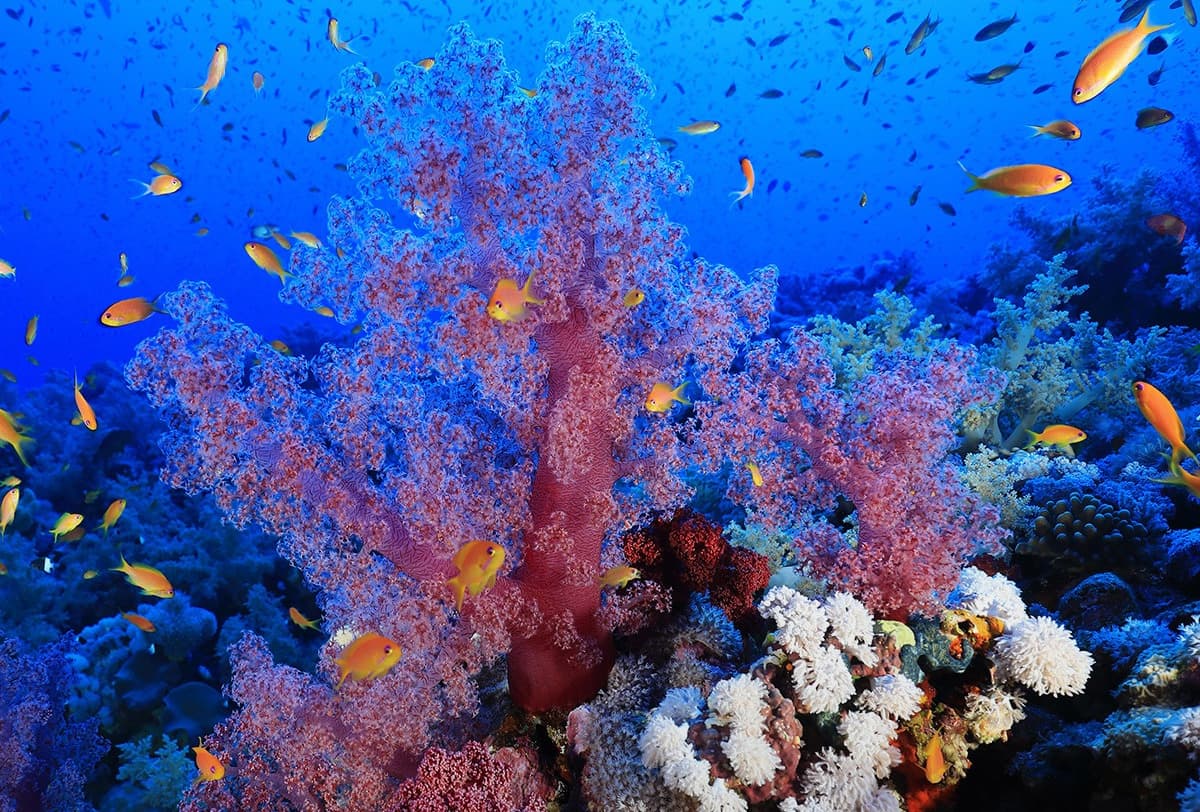
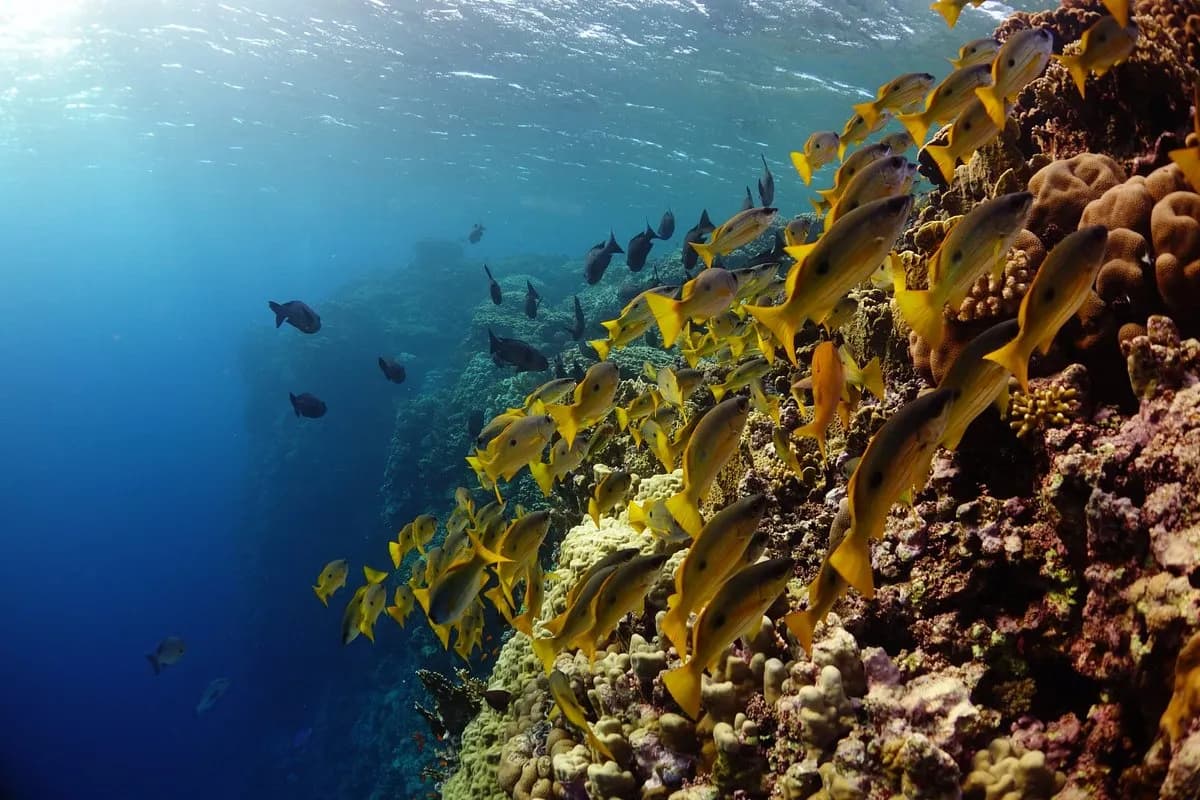
Elphinstone is a long, narrow reef oriented north to south, plunging steeply into the deep blue from both sides. Its sheer vertical walls are covered in vibrant soft corals, sea fans, and gorgonians, offering a visual feast for divers.
- The northern plateau is often swept by strong currents, attracting pelagic species.
- The southern plateau slopes more gently and is great for slower-paced exploration.
- Caves, overhangs, and pinnacles provide both beauty and shelter for marine life.
The structure of the reef allows for both drift dives and technical diving, depending on the current and diver experience.
🐬 Marine Life at Elphinstone Reef
Elphinstone is famous for its big fish action and diverse ecosystem. Divers regularly encounter:
- 🦈 Oceanic whitetip sharks (Longimanus) – especially in autumn
- 🔨 Hammerhead sharks – often seen near the northern plateau
- 🐢 Green turtles and hawksbill turtles
- 🐟 Large schools of jacks, trevallies, and barracudas
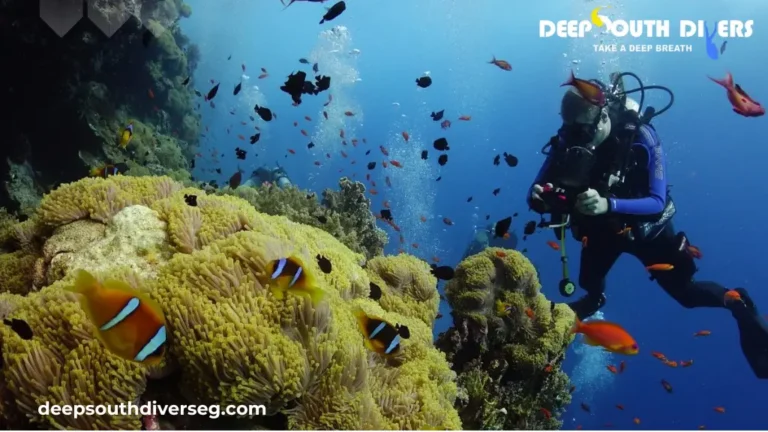
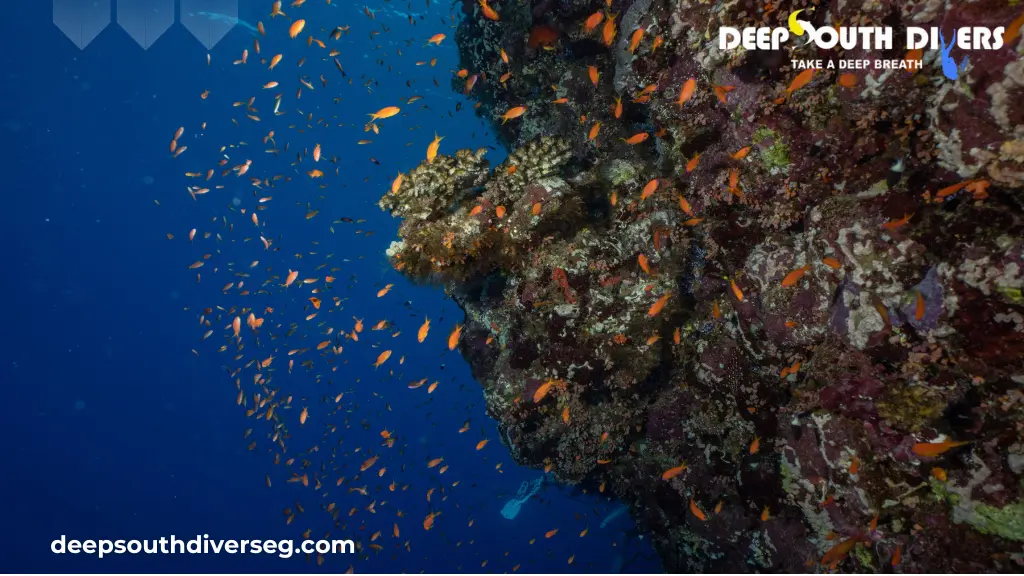
- 🐙 Colorful reef residents like anthias, moray eels, nudibranchs, and clownfish
- 🪸 Massive soft coral formations and red gorgonians
This biodiversity makes every dive at Elphinstone a unique experience.
Diving Conditions & Best Practices
📅 Best Time to Dive
- March to June: Ideal conditions and high visibility
- September to November: Shark sightings peak, especially oceanic whitetips
🌊 Water Temperature
- Ranges from 22°C (Jan) to 30°C (Aug)
🌪️ Currents & Visibility
- Currents: Moderate to strong – great for drift dives
- Visibility: Typically 20–40 meters
✅ Best Practices
- Always dive with an experienced local guide
- Use a surface marker buoy (SMB) on ascent
- Ideal for experienced divers due to depth and current
- Nitrox is recommended for extended bottom times
Why Dive Elphinstone Reef with Deep South Divers?
Choosing Deep South Divers gives you exclusive access to the best diving experience in southern Egypt:
- 🚤 Fast, safe boats departing daily from Marsa Alam
- 🧭 Expert local guides with years of Red Sea diving experience
- 🦺 Safety-first approach with briefings, SMBs, and emergency planning
- 📷 Underwater photography and videography services
- 🐟 Focused eco-diving experiences, preserving reef health
Whether you’re chasing shark encounters, exploring dramatic drop-offs, or just want a world-class dive, Elphinstone Reef is a must-see—and no one does it better than Deep South Divers.
History and Legends of Elphinstone Reef
Elphinstone Reef takes its name from Mountstuart Elphinstone, a Scottish statesman and colonial administrator who served the British East India Company during the early 19th century. The reef was charted and named during the era of British maritime surveying in the Red Sea, when the region’s shipping lanes were being mapped for the first time.
Since its discovery by the diving world in the late 20th century, Elphinstone Reef has earned a legendary reputation among Red Sea divers. Its remote offshore position, dramatic vertical walls, and reliable shark encounters quickly established it as one of the bucket-list sites of global diving.
No legend is more captivating, however, than that of the Sarcophagus — a deep natural arch located at the northern end of the reef at depths between 50 and 70 metres. Local dive lore describes the arch as a “coffin-shaped” passage that draws technical divers into the blue abyss. Stories of divers who followed its pull and never returned have circulated for decades, blending genuine caution about the depth and current with the kind of myth that only the sea can generate. Whether or not the stories are true, the Sarcophagus remains one of the most talked-about features of Elphinstone Reef and a powerful reminder of the respect this site demands.
Dive Site Layout: North vs. South Plateaus
Elphinstone Reef stretches approximately 300 metres from north to south, and understanding the difference between its two plateaus is essential for planning a great dive.
The Northern Plateau The northern end of Elphinstone Reef is where the action is. Starting at around 18–25 metres and dropping sharply into open blue water, this plateau is exposed to the strongest currents on the reef. That current is precisely what attracts large pelagic species — oceanic whitetip sharks patrol this area year-round, and schools of hammerheads are regularly sighted here in the early morning hours. The most famous feature of the northern plateau is the deep underwater arch known as the Sarcophagus, accessible only to experienced technical divers. The walls here are draped in large sea fans and gorgonians, and the open-water exposure gives the whole dive an exhilarating, blue-water feel.
The Southern Plateau The southern end of Elphinstone Reef has a gentler character. The plateau here begins at a shallower depth and the walls slope more gradually, making it better suited to relaxed exploration. This is where you’ll find dense soft coral gardens, macro life in the overhangs and crevices, and a higher density of reef fish. Moray eels, nudibranchs, clownfish, and anthias dominate the reef scene. The currents here are typically lighter, which also makes the south plateau a good option for safety stops on ascent. Many guided dives at Elphinstone Reef begin at the north plateau for the pelagic highlights and drift south to finish with the reef’s calmer, more colourful section.
Required Certifications and Experience Level
Elphinstone Reef is not a dive site for everyone — and that’s part of what makes it so special. The depth, the open-sea location, and the strength of the currents all demand a solid level of diving experience.
Minimum certification: Advanced Open Water Diver (AOWD) or equivalent (SSI Advanced Adventurer or higher). An AOWD certification ensures the diver has completed a deep dive module and has experience beyond the 18-metre Open Water limit.
Recommended certification: For divers who wish to explore the deeper sections of the northern plateau or attempt drift dives in strong current, a PADI Deep Diver specialty or an equivalent advanced qualification is strongly recommended.
Logged dives: Most reputable dive centres, including Deep South Divers, require a minimum of 30–50 logged dives before taking guests to Elphinstone Reef. This is not a bureaucratic formality — it reflects the reality that the reef’s depth and unpredictable currents require divers to be confident with buoyancy control, air management, and responding calmly to changing underwater conditions.
Nitrox certification: While not mandatory, an Enriched Air Nitrox (EANx) qualification is highly beneficial at Elphinstone Reef. The deeper sections of the dive consume no-decompression limits quickly, and Nitrox gives certified divers a meaningful extension of safe bottom time — especially useful when shark activity keeps the group at depth longer than planned.
Divers who do not yet meet these requirements should not be discouraged. Deep South Divers offers Advanced Open Water and Nitrox courses in Marsa Alam, and a few days of skills development is all that stands between an aspiring diver and one of the Red Sea’s greatest experiences.
Essential Dive Gear and Equipment for Elphinstone Reef
Packing the right equipment is not optional at Elphinstone Reef — it is a safety requirement. The open-sea location means that in the event of a drift separation, a diver must be able to signal the surface and wait for pickup independently. Here is the essential gear list:
🔴 Surface Marker Buoy (SMB) — Required Every diver at Elphinstone Reef must carry a personal SMB. The reef sits 12 km offshore, and a diver surfacing away from the boat can be extremely difficult to spot without one. A brightly coloured, fully inflated SMB is your most important piece of safety equipment on this dive.
💻 Dive Computer — Required With depths ranging from 18 to 70+ metres, manual dive tables are not a realistic option at Elphinstone Reef. A reliable dive computer with a clear depth and no-decompression limit display is non-negotiable.
🔵 Enriched Air Nitrox (EANx) — Strongly Recommended As noted above, Nitrox significantly extends bottom time at depth. Deep South Divers fills Nitrox tanks on-site for certified divers.
🪝 Reef Hook — Recommended When currents at Elphinstone Reef peak in strength, a reef hook allows divers to hold position without damaging coral and without exhausting themselves finning against the flow. This is particularly useful on the northern plateau when watching for sharks.
🧲 Dive Light / Torch — Recommended The overhangs, caves, and crevices on both plateaus are home to a wealth of marine life that is invisible without a light. A compact torch makes a significant difference to the quality of your dive.
🦺 Wetsuit (3mm–5mm) Water temperature at Elphinstone Reef ranges from 22°C in January to 30°C in August. A 3mm wetsuit suits most divers in summer; a 5mm suit is recommended for winter visits and for the deeper, cooler sections of the reef.
Additional items: whistle or dive alert, delayed SMB (if your primary SMB is a standard open-base model), and an audible surface signalling device.
Shark Interaction Safety and Etiquette at Elphinstone Reef
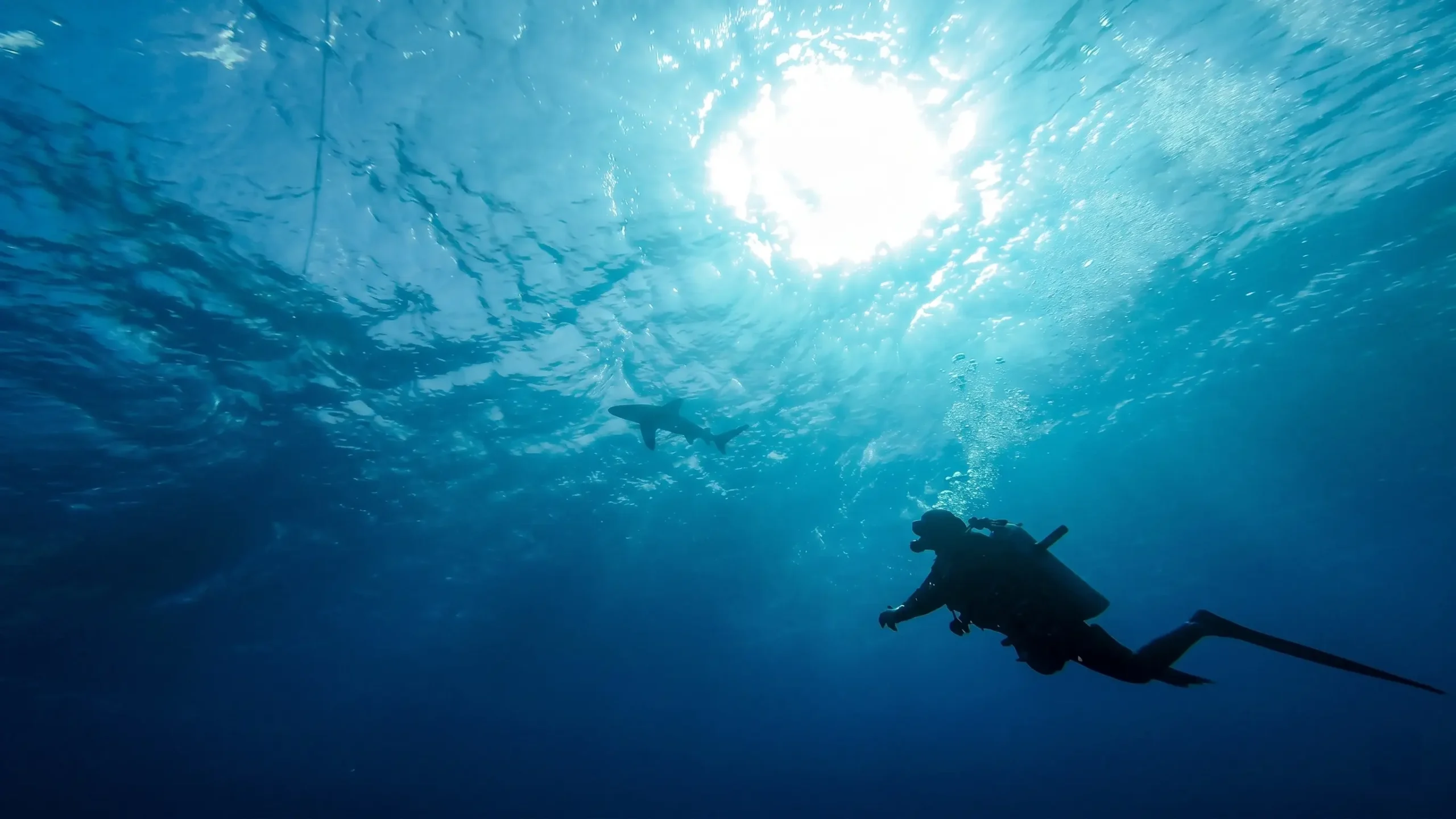
Elphinstone Reef is one of the most reliable places in the world to see oceanic whitetip sharks (Carcharhinus longimanus) and, in season, scalloped hammerheads. Shark encounters here are extraordinary, but they also require divers to behave in a way that is both safe for themselves and respectful of the animals.
Before the dive: Always attend the full dive briefing. Your guide from Deep South Divers will cover the specific shark behaviour expected that day based on current conditions and recent sightings. Never enter the water ahead of your guide.
During the dive — key rules:
- Maintain neutral buoyancy at all times. Sharks are strongly attracted to erratic, struggling movements. A diver who is fighting the current, kicking frantically, or ascending rapidly at speed mimics the behaviour of distressed prey. Neutral buoyancy is your single most important tool for a safe shark encounter at Elphinstone Reef.
- Stay close to the group. Oceanic whitetips in particular are curious and confident sharks. Isolated divers are far more likely to attract close investigative passes. Staying together in a compact group presents a larger, more unified presence and generally keeps interactions calm.
- Avoid rapid movements toward the surface. Surfacing quickly, especially if there are sharks in the water, can trigger a reaction. Always ascend slowly and deliberately, and always deploy your SMB before reaching the surface.
- Do not touch or corner the animals. Chasing a shark for a better photograph, reaching out to touch one, or blocking its exit route can provoke a defensive response. Observe from a respectful distance and let the animals approach you on their own terms.
- Avoid entering the water bleeding. Even minor cuts can be problematic in shark-heavy water. Inform your guide of any open wounds before the dive.
Oceanic whitetip sharks at Elphinstone Reef are not inherently dangerous when divers behave correctly. Incidents at this site have almost always involved violation of one of the above principles. With proper conduct, an encounter with a Longimanus is among the most awe-inspiring experiences diving has to offer.
How Elphinstone Reef Got Its Name (and Its Local Name, Sha’ab Abu Hamra)
Few divers realise that the name Elphinstone Reef is a piece of nineteenth-century maritime history rather than a marine-biology term. Egyptian dive guides usually know the reef by its Arabic name, Sha’ab Abu Hamra, but on the world’s charts it carries the surname of a British colonial statesman — a small fragment of empire stranded in the middle of the southern Red Sea.
The reef is named after Mountstuart Elphinstone (1779–1859), a Scottish historian and the former governor of Bombay under the East India Company. The story behind the naming is genuinely dramatic. On 18 December 1827, Elphinstone was sailing home to England via Egypt when his ship very nearly came to grief on an uncharted shoal — the breakers of what we now call Elphinstone Reef. The passengers spotted the white water only a mile off, were briefly becalmed in water far too deep to anchor, and survived only because a light breeze picked up and carried them clear toward the old port of Quseir.
The ship’s captain carefully recorded the bearings of this previously unmarked hazard, and a few years later, around 1830, Commander Robert Moresby of the Indian Navy formally added it to the Admiralty charts under the name Elphinstone Reef. In other words, the site that today draws divers from around the world was first “discovered” as a near-shipwreck and logged as a danger to navigation — a reputation it still half-deserves, given its open-sea exposure and powerful currents.
Understanding this history adds real depth to a dive here. When you roll off the boat onto Elphinstone Reef, you are descending onto the summit of an undersea mountain that sailors feared for the better part of two centuries before scuba divers came to love it. The contrast between that old reputation as a ship-killer and its modern status as one of Egypt’s premier shark dives is part of what gives the site its mystique.
For divers planning a trip, the practical takeaway is simple: if a local skipper or guide refers to “Abu Hamra,” they mean Elphinstone. Knowing both names helps when you are comparing dive operators, reading older logbooks, or talking with Egyptian crew who have fished and dived these waters for generations. It is also a reminder that you are diving a site with a documented past stretching back to the first ship logs of 1827.
The Elphinstone Arch: The Reef’s Legendary Pharaoh’s Tomb
No feature captures the imagination of divers quite like the Elphinstone Arch. Hidden near the southern tip of the reef, this dramatic underwater archway tunnels through the reef structure at roughly 52 to 65 metres, connecting the two great walls of the reef in the deep blue. It is the single most mythologised feature of Elphinstone Reef, and for good reason.
Local legend holds that the arch shelters the tomb of an ancient Egyptian pharaoh. Within the structure lies a coral-encrusted, sarcophagus-shaped outcrop, and in the dim light at that depth it is easy to see how the story took hold. Whether you believe the folklore or treat it purely as an evocative rock formation, the “pharaoh’s sarcophagus” has become an inseparable part of Elphinstone’s identity and one of the most asked-about features of the site.
It is essential to be honest about what reaching the arch actually involves. At 52 to 65 metres, the Elphinstone Arch sits firmly in technical diving territory — well beyond recreational no-decompression limits and far below the depth most divers should ever consider. Visiting it safely requires proper technical training, appropriate gas mixes (such as trimix), redundant equipment, and meticulous decompression planning. It is absolutely not a feature to “have a quick look at” on a recreational dive.
For the overwhelming majority of visitors, the arch is best appreciated as part of the reef’s lore rather than as a dive objective. Recreational divers exploring the southern plateau can enjoy the spectacular walls, the soft corals, and the pelagic action in the 18–30 metre range while knowing the famous arch lies in the shadows below — a tantalising reminder of just how far Elphinstone plunges into the abyss. Chasing depth here, far from shore and in unpredictable currents, has cost lives, and no photograph is worth that risk.
If exploring features like the arch one day appeals to you, the right path is to build experience and training progressively. Mastering buoyancy, deep-diving theory, and gas management through structured courses — beginning with the Advanced Open Water course in Marsa Alam and continuing toward technical qualifications — is the only responsible way to expand your limits at a site as demanding as Elphinstone.
Elphinstone’s Depth Profile & East–West Wall Strategy
Beyond the broad description of plateaus and walls, it pays to understand the precise shape of Elphinstone Reef, because the site’s geometry directly determines how — and how deep — you dive it. The reef is a narrow ridge roughly 300 metres long and only about 20 to 40 metres wide, with a central spine that rises so close to the surface that the middle section sits in just one to two metres of water and is often visible as breaking white water from the boat.
From that shallow spine, the reef falls away in dramatically different ways at each end. The northern plateau steps down to around 42 metres and holds two distinct coral pinnacles, while the southern plateau tapers to an arrowhead point at roughly 40 metres before the structure drops vertically. Beyond the plateaus, the walls plunge in near-vertical cliffs to 80, 100 metres and ultimately into several hundred metres of open ocean — which is exactly why depth discipline matters so much here.
The two long walls have distinct personalities, and experienced guides plan around them. The eastern wall is the steeper, more sheer of the two, dropping away almost perpendicularly into the blue. The western wall is slightly less severe and a touch sandier, broken up by overhangs and small caves that shelter reef life and reward slow, observant diving. Knowing which wall you are on tells you what to expect underfoot and overhead.
There is also a light-management strategy that separates a good Elphinstone dive from a great one: dive the eastern wall in the morning and the western wall in the afternoon. This keeps the sun at your back and behind the reef, illuminating the pink and red soft corals, the gorgonian fans, and the schooling fish rather than leaving them in shadow. For underwater photographers, timing your wall around the sun is the difference between flat, grey images and the glowing, colour-saturated shots Elphinstone is famous for.
Crucially, you do not need to go deep to enjoy this reef. Most of Elphinstone’s signature scenery — the soft-coral walls, the gorgonians, the anthias clouds, and even many shark encounters — unfolds comfortably above 30 metres. The northern pinnacles at ~42 metres and the deeper structures are optional extras for suitably qualified divers, not the main event. Planning a sensible maximum depth in advance, and sticking to it, is the single best decision you can make at this site.
Mastering the Currents: Drift Diving Elphinstone Safely
The currents at Elphinstone Reef are both its greatest gift and its greatest hazard. They are what bring nutrient-rich water sweeping past the reef, fuelling the explosion of life that draws sharks and big pelagics — and they are also what make this a dive strictly for those comfortable in moving water and open sea.
The current here is variable but usually runs from north to south along the east and west walls, frequently at two knots or more. The classic and safest way to work with it is as a drift dive: divers drop in near the northern point — often the most likely spot for a shark encounter — and let the flow carry them southward along the wall, while the boat tracks them and collects them at the southern end. Going with the current rather than fighting it conserves air, reduces stress, and lets you focus on the reef and the blue.
What makes Elphinstone unforgiving is that it is fully exposed to the open sea with nowhere to shelter. Unlike a coastal bay, there is no lee to duck behind if conditions turn. The current can also shift unexpectedly — on rare occasions it has reversed and run northward — so your guide must be prepared to read the water and adjust or abort the plan accordingly. A good Elphinstone briefing always covers the current direction, the planned drift, the lost-buddy procedure, and what to do if you surface away from the boat.
Carrying and knowing how to deploy a delayed surface marker buoy (DSMB) is non-negotiable here. Because divers can drift well away from the reef and the boat during ascent, a high-visibility SMB sent up before you reach the surface is what allows the crew to track you in open water. A whistle and a signalling mirror or light add further layers of safety should you end up bobbing in choppy seas waiting for pickup.
None of this should frighten away an appropriately experienced diver — drift diving is exhilarating and, done properly, is the most natural way to experience this reef. But it does mean Elphinstone rewards preparation and punishes complacency. Diving with a guide who knows the site’s moods intimately, in a small and competent group, transforms the currents from a threat into the very thing that makes the dive unforgettable.
Diving with Oceanic Whitetip Sharks at Elphinstone
If one animal defines Elphinstone Reef, it is the oceanic whitetip shark (Carcharhinus longimanus). Elphinstone is one of the very few places on Earth where divers can reliably come face to face with this open-ocean predator, and the encounter is the main reason many travellers make the journey to the southern Red Sea at all.
Oceanic whitetips are unmistakable: stocky, with broad, rounded, white-tipped fins, and almost always trailed by a loyal escort of pilot fish. Unlike most sharks, they are genuinely curious about divers and tend to cruise the upper water column, which means you often do not need to go deep to meet them — descending just ten metres or so off the plateau can be enough for a close pass. The peak season is generally October to December, when individuals concentrate around the reef; at the height of the season, experienced guides have reported seeing twenty or more in a single day.
The reef has even become a focus for shark science. A photo-identification study carried out at Elphinstone between 2016 and 2019 catalogued 105 individual oceanic whitetips — overwhelmingly females — confirming that the reef is an important habitat for the species, most likely because of the rich supply of prey the currents deliver. That research underlines something important: these are not random visitors but a recognisable, returning population, which is exactly why responsible behaviour around them matters so much.
It is vital to respect these animals. Oceanic whitetips are bold and inquisitive; they will circle divers, approach closely, and occasionally bump or nose them. They are not hunting humans, but their confidence demands calm, disciplined behaviour. Follow these guidelines on every dive when whitetips may be present:
- Stay in a group. A tight group presents a larger, more confident profile and dramatically reduces risk compared to a lone, scattered diver.
- Stay calm and control your breathing. Fast, panicky movements and erratic finning attract attention; relaxed neutral buoyancy does not.
- Never chase, corner, or touch a shark, and never block its path.
- Keep relatively close to the reef where appropriate, limiting the open water around and below you so you are less likely to be surprised.
- Maintain eye contact with an approaching shark and calmly reposition rather than turning your back and swimming away.
One serious problem deserves a direct mention: shark feeding. Some operators and divers have, irresponsibly, fed sharks from boats at Elphinstone, and many believe this has made the local whitetips more assertive and quicker to approach — raising the risk for everyone. There has been at least one documented bite incident at the reef. Choosing a dive centre that strictly refuses to feed or bait sharks, and that briefs proper behaviour, is not just an ethical choice but a safety one. To learn more about the region’s species and how to behave around them, see our guide to the sharks of Marsa Alam.
Hammerheads, Whale Sharks & Other Big Pelagics
Oceanic whitetips may headline the show, but Elphinstone Reef is a genuine big-animal arena, and on the right day the supporting cast is extraordinary. Understanding where and when to look for each species turns a good dive into a memorable one.
Hammerhead sharks — usually scalloped hammerheads — are the second great draw. The best place to spot them is out in the deep blue off the northern point, where these large animals (often 200 kilograms or more) typically patrol below 60 metres. For most of the year they stay deep, making them a privilege reserved for experienced divers watching the blue; but in the summer months they sometimes rise into shallower, more visible water, bringing them within reach of a wider range of divers.
Beyond the two famous sharks, Elphinstone’s open-water position attracts a remarkable roster of pelagics that the reef’s resident community alone cannot match. Over the years divers and dive databases have recorded:
- Whale sharks — rare but unforgettable seasonal visitors gliding past the walls.
- Manta rays and mobula rays — occasional but spectacular, particularly in the warmer months.
- Tiger, silky, grey reef, and blacktip sharks — all logged here, with grey reef and silky sharks among the more regular guests.
- Thresher sharks — a genuine rarity, but not unheard of in the wider area.
- Giant Napoleon (humphead) wrasse — curious, car-sized residents that often approach divers.
- Schooling dogtooth tuna, jacks, trevallies, blackfin barracuda, and fusiliers — the silver “bait-ball” backdrop that signals a healthy, current-fed reef.
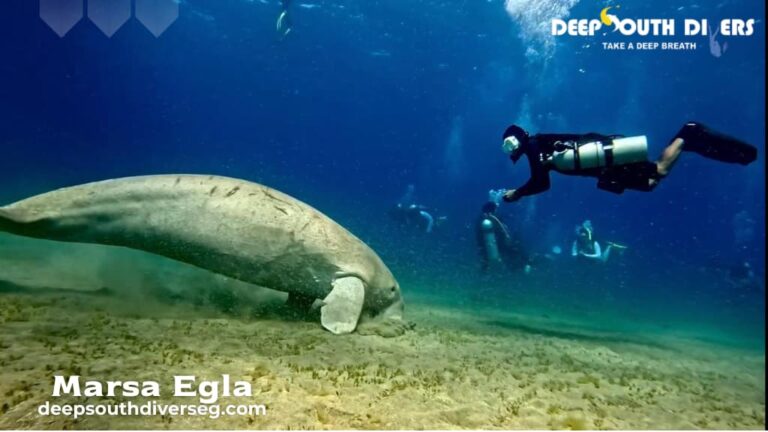
There is also one persistent myth worth correcting. Some visitors arrive at Elphinstone hoping to see a dugong (“sea cow”), only to leave disappointed. Dugongs are seagrass grazers and simply do not live on a deep, open-ocean coral pinnacle like Elphinstone; they favour the shallow seagrass meadows of bays such as Abu Dabbab. If a gentle dugong encounter is on your wish list, it belongs on a different itinerary — see our guide to the dugong of Marsa Alam and the Abu Dabbab seagrass bay rather than Elphinstone.
The common thread is that nothing here is guaranteed — these are wild animals in open water. What Elphinstone offers is one of the highest concentrations of big-pelagic potential anywhere in the Egyptian Red Sea, and the magic of never quite knowing what will emerge from the blue.
Are You Ready for Elphinstone? Experience, Certification & Safety
Elphinstone Reef is a world-class dive, but it is also one that has tested — and occasionally overwhelmed — divers who were not ready for it. Being honest with yourself about your experience is the most important safety decision you will make, so this section sets out clearly what the reef demands.
Who should dive Elphinstone?
As a guideline, you should hold at least an Advanced Open Water certification, have logged a meaningful number of dives (many experienced guides suggest around 50 or more), and crucially have genuine experience of deep diving, drift diving, and diving in open, sometimes choppy seas. A confident intermediate diver in calm conditions and a diver comfortable being swept along an exposed wall in two knots of current are two very different things. If you are still building those skills, it is far better to develop them first at sheltered local sites and return to Elphinstone properly prepared.
Essential equipment and gas
Beyond your standard kit, certain items are effectively mandatory here. A DSMB and reel for signalling on ascent, an audible signal such as a whistle, and a visual aid such as a signalling mirror or torch can be the difference between a quick pickup and a long, frightening drift in open water. A reliable dive computer is essential given the depths involved, and nitrox is highly recommended to extend bottom time and add a conservative buffer — consider an Enriched Air Nitrox course in Marsa Alam if you are not already certified.
Respect the open sea
Elphinstone’s history includes sobering reminders of what can go wrong when divers, currents, and the open sea combine badly — including past incidents in which divers drifted away from their boat in unexpected conditions. The enduring lessons from those events are simple and worth repeating: never exceed your training or planned depth, always carry surface-signalling equipment and know how to use it, dive within a disciplined group, and follow a thorough briefing every single time. Surface-signalling devices are not optional accessories at this site; they are core safety gear.
Finally, choose your operator with care. A responsible dive centre will check your certification and logged experience honestly, brief the current and emergency procedures in detail, keep groups small, refuse to bait sharks, and be willing to change or call a dive if conditions deteriorate. None of this dampens the adventure — it is precisely what allows you to enjoy one of the planet’s great shark dives with confidence. If you want to build the skills and confidence to dive Elphinstone the right way, our Rescue Diver course in Marsa Alam and guided progression dives are an ideal foundation.
Day Trip vs Liveaboard: Two Ways to Dive Elphinstone
There are two very different ways to experience Elphinstone Reef, and the right one depends on your time, budget, and how much of the southern Red Sea you want to see. Because the reef lies relatively close to the coast, it is one of the few iconic Egyptian sites you can reach on a single day trip — yet it also features on many southern liveaboard itineraries.
| Aspect | Day Trip (from Marsa Alam / Port Ghalib) | Liveaboard Safari |
|---|---|---|
| Access | Daily boat from the coast; ideal if you are based on land in Marsa Alam or El Quseir | Multi-day cruise, often combining Elphinstone with Brothers & Daedalus (BDE) or Fury Shoals & St John’s |
| Dives at Elphinstone | Typically 1–2 dives on the day | Multiple dives, often across different walls and times of day |
| Crowds | Arrives mid-morning with other day boats | Can dive at dawn, before day boats reach the reef |
| Best for | Travellers on a beach holiday wanting a taste of Elphinstone | Dedicated divers wanting remote sites and maximum shark time |
| Commitment | One day, lower cost | Usually a week, higher cost, more remote diving |
Whichever option you choose, timing within the day matters enormously. Elphinstone is popular, and by eight or nine in the morning several liveaboards and day boats can be moored on the reef at once, filling the water with divers and zodiacs. Getting in at or near dawn is the single best way to enjoy quieter water — and, as a bonus, the early morning is also one of the most likely times to encounter sharks.
This is the main practical advantage liveaboards hold: by overnighting near the reef, they can put divers in the water before the day boats arrive. That said, a well-run day trip that departs early and reaches the site promptly can still deliver superb diving, especially in the shoulder seasons when the reef is less crowded. The key in either case is an operator who plans around the crowds and the light rather than simply turning up at peak time.
For divers basing themselves on the coast, a day trip with a local centre that knows Elphinstone intimately is the simplest, most flexible way to dive it — and it pairs naturally with the wider variety of Marsa Alam dive sites you can explore across a week-long stay, from gentle house reefs to the deeper offshore walls.