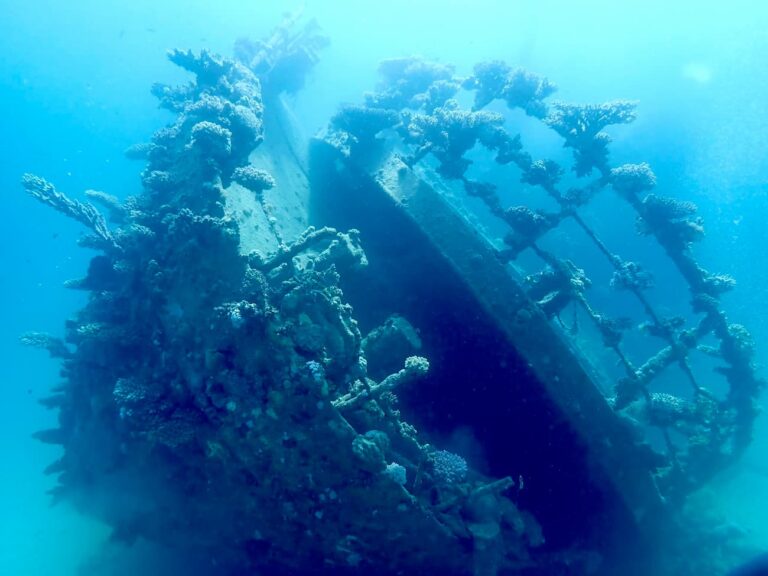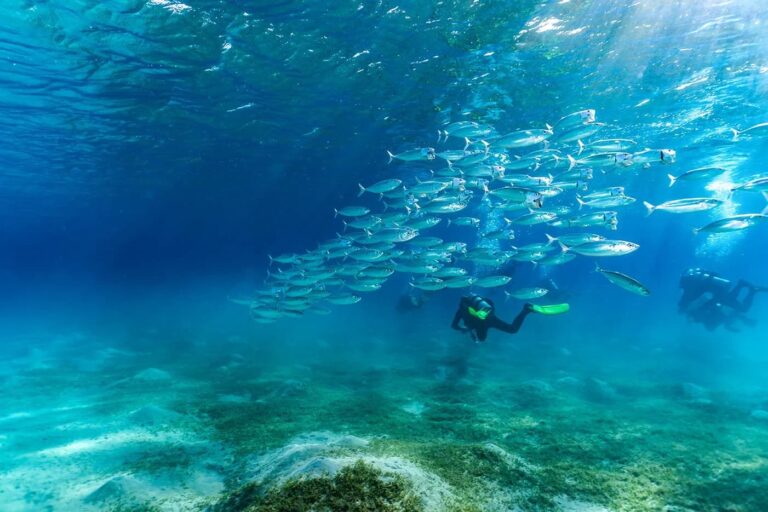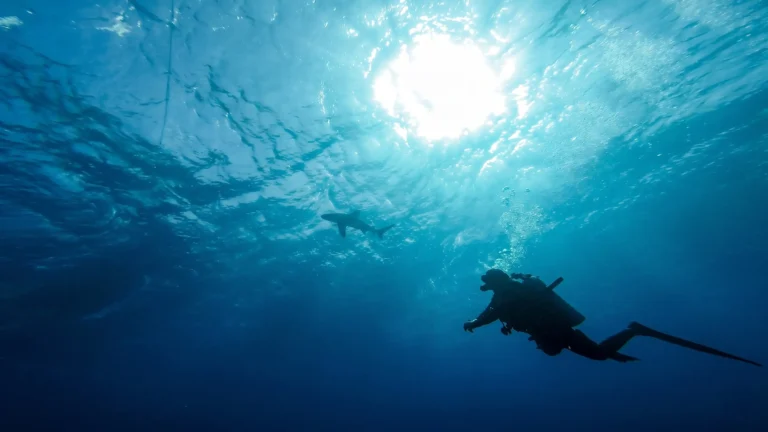
Rising sheer from a seabed nearly half a kilometre down, marooned in the open blue some 80 kilometres off the Egyptian coast, Daedalus Reef is the dive that serious Red Sea divers cross continents to experience. There is no land in sight—only a lone, zebra-striped lighthouse breaking an otherwise empty horizon, and beneath it, walls of living coral plunging into water so deep and so nutrient-rich that schooling hammerheads, oceanic whitetips and the occasional thresher patrol it as a matter of routine. If you have ever asked which single site delivers the Red Sea’s most reliable big-pelagic action, this is the answer.
Accessible only by liveaboard and protected within a marine park, Daedalus has earned a near-mythical reputation. It is remote enough to remain pristine, productive enough to draw the ocean’s apex predators, and demanding enough that it rewards experienced divers above all. This guide draws on first-hand diving knowledge and the most current information available to cover everything you need: the geography and history of the reef, its named dive zones, the marine life you can realistically expect, the conditions and certifications required, the best months to visit, and how a Daedalus liveaboard trip actually unfolds.
Whether you are planning your first trip to the southern Red Sea or returning to chase the summer hammerhead schools, this is the most thorough Daedalus Reef resource you will find. Let’s dive in.
Where Is Daedalus Reef? Location and Geography
Daedalus Reef sits in glorious isolation in the middle of the Egyptian Red Sea, roughly 80 to 100 kilometres east-southeast of Marsa Alam and more than 300 kilometres south of Hurghada. In practical sailing terms it lies about 52 nautical miles offshore—around a six-hour crossing from the nearest coast in calm conditions. Look at a chart and you’ll see why it feels so wild: it is positioned almost exactly halfway between the Egyptian and Saudi Arabian coastlines, making it the furthest offshore reef on the Egyptian side of the sea.
The Reef Platform and Its Walls
The reef is a large, elongated oval—often described as tear-drop or finger-shaped—that rises abruptly from a seabed approximately 450 to 550 metres deep. Its surface platform measures roughly 1,075 metres long by 300 metres wide. The edges drop away in sheer walls and steep slopes: typically a vertical drop to around 20 metres, then a sloping shoulder out to about 40 metres, before the wall plunges into the abyss. This vertical topography, combined with the deep water that surrounds it on every side, is the engine behind everything that makes Daedalus special.
Why Isolation Equals Productivity
Daedalus is a true oceanic seamount. With no neighbouring reefs to shelter it, it is fully exposed to wind, swell and the powerful upwelling currents that sweep nutrient-rich water up from the depths. Those nutrients fuel plankton, plankton feeds the reef fish, and the dense fish life draws in the large pelagic predators. The reef’s open-ocean exposure also means the water is exceptionally clear—visibility regularly exceeds 30 metres—and its marine-park status keeps the corals in superb condition.
The Name: Daedalus Reef and “Abu Kizan”
The reef carries two names, and the story behind each adds character to the dive.
Abu Kizan—The Local Name
Locally, the reef is known as Abu Kizan (أبو كيزان), which derives from the Arabic word “kizan,” meaning pots or pottery. The most popular local legend holds that a vessel carrying a cargo of pots on its deck struck the reef’s northern side and sank. No wreckage from such a ship has ever been confirmed, so the tale remains folklore rather than fact—but it is the name Egyptian crews still use.
The Greek Connection
The English name evokes Daedalus, the master craftsman of Greek myth who built the Cretan labyrinth and the wax wings for his son Icarus. Romantic as that association is, the reef was almost certainly named not for the myth directly but after HMS Daedalus, a Royal Navy vessel—a reflection of nineteenth-century British surveying activity in the region rather than ancient legend.
The Iconic Daedalus Reef Lighthouse
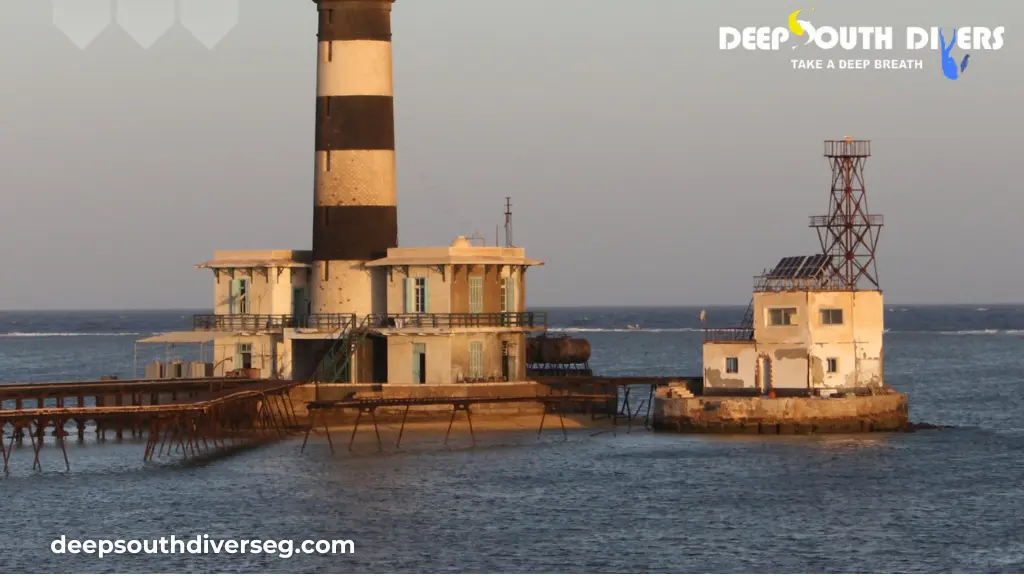
No description of Daedalus Reef is complete without its most recognisable feature: the tall, black-and-white horizontally striped lighthouse standing on a small artificial island at the reef’s centre. For divers waking on a liveaboard moored to the south, it is the first sight of the day and an unmistakable landmark.
A History of Continuous Service Since 1863
The lighthouse has been an active aid to navigation since 1863, when the original tower was erected under British initiative and financing in the era of the Suez Canal’s opening. That first structure was a conical cast-iron tower roughly 18 metres tall, painted red, served by a jetty of about 100 metres. A lonely reef in the middle of a busy shipping route was a serious navigational hazard, and the light was built to mark it. The tower was rebuilt in 1931 and renovated in 1993.
The Lighthouse Today
The current lighthouse stands roughly 30 metres tall, and its light is visible from up to 15 nautical miles away. Beside it sits a two-storey building that accommodates the Egyptian Coast Guard and Navy personnel stationed there, accessed by long piers—of which one remains in regular use.
Visiting the Lighthouse Between Dives
Many liveaboards offer a surface visit to the lighthouse during the day’s surface intervals. You step off the tender, walk the pier and meet the attendants, who famously sell a unique souvenir T-shirt available nowhere else (typically around €10). It’s a charming, low-key highlight and a rare chance to set foot on dry land in the middle of the open sea.
Dive Sites and Zones at Daedalus Reef
Although Daedalus is a single reef, its different aspects fish so distinctly that they function as separate dive sites. Most dives here are drift dives along the walls, with your route dictated largely by the day’s current. A good rule of thumb is to dive the eastern wall in the morning and the western wall in the afternoon, following the sun to light up the corals.
The Northern Tip—Hammerhead Central
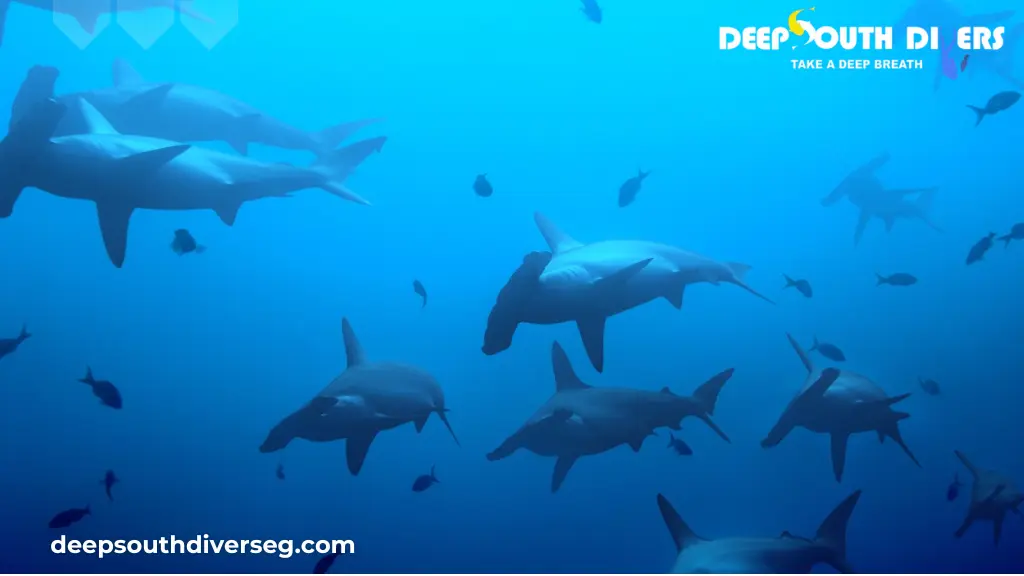
The northern point is the headline act. Here the current splits around the reef and upwelling water rises along the east wall, frequently drawing scalloped hammerheads in at depth. It is the single best location at Daedalus—and arguably in the entire Red Sea—to encounter hammerheads schooling out in the blue. Divers typically hang in the current near the drop-off at 25 to 40 metres, watching the open water for the unmistakable silhouettes to materialise.
East Wall vs. West Wall at the North
Both northern walls offer prime pelagic potential. The east wall catches the strongest upwelling and is the classic hammerhead and oceanic-whitetip station in the morning light. The west wall shares a similar profile with notably dense hard-coral coverage, and the partially collapsed remains of the original lighthouse jetty rest on the seabed here, diveable for those who venture down.
The Western Wall and “Anemone City”
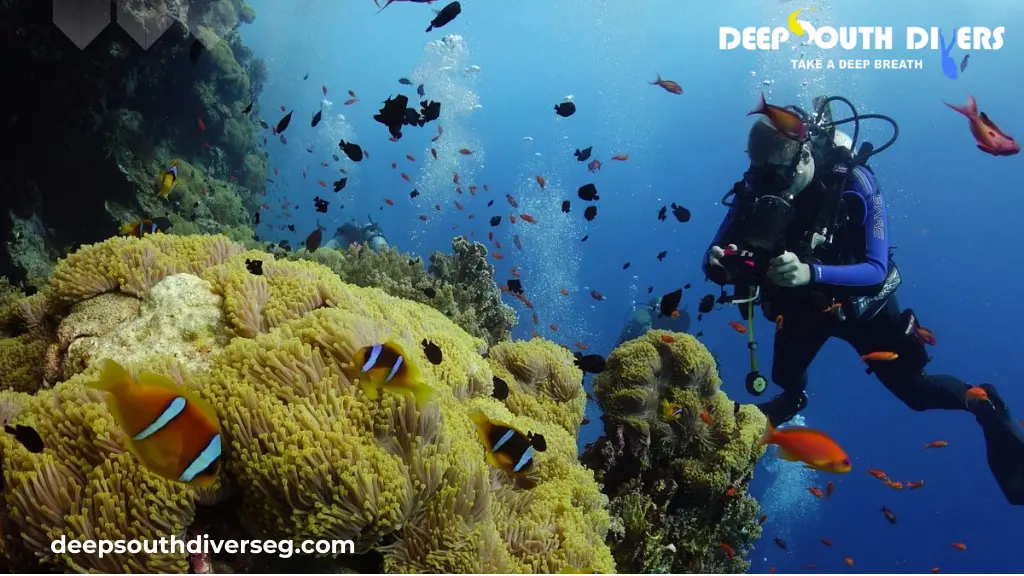
The western wall offers the most variety of any aspect of the reef. Its standout feature is a remarkable shallow formation—often called “Anemone City”—where an entire stretch of wall at just 5 to 10 metres is carpeted with sea anemones swaying in the current, home to endemic Red Sea anemonefish and dottybacks. It is a macro photographer’s dream and a welcome contrast to the adrenaline of the deep blue. The wall also features huge porites hard-coral formations, crevices sheltering moray eels, and busy cleaning stations where wrasse service queues of unicornfish and groupers.
The Southern Plateau
The southern side is the most sheltered part of the reef, where currents tend to ease and the liveaboards moor. A large sandy plateau stretches out at 30 to 40 metres, dotted with soft corals and the scattered remains of the old pier. This is where curious oceanic whitetip sharks frequently circle beneath the boats, where green and hawksbill turtles graze, and where large Napoleon wrasse patrol. Because conditions here can be gentler, the southern plateau is the most forgiving introduction to the site.
The Zealot Wreck—For Technical Divers Only
Deep on the wall lies the wreck of the Zealot, a steamer that struck the reef and now rests on the drop-off at roughly 80 to 100 metres. Steel beams from its cargo can be spotted higher up on the reef wall, but the wreck itself—largely untouched, with dinner plates and two anchors strewn across the slope—is firmly in technical-diving territory and well beyond recreational limits.
Marine Life at Daedalus Reef: What You’ll See
Daedalus is celebrated as one of the most significant aggregation sites for large pelagic species in the entire Red Sea. Scientific surveys here have recorded some of the highest shark encounter rates in the southern Red Sea, with a single study documenting eight distinct shark species at the reef. But the sharks are only the beginning.
The Sharks of Daedalus
- Scalloped hammerheads: The reef’s signature species, most often seen schooling off the northern tip, peaking in spring and through the summer months. Hammerheads are sensitive to diver noise and tend to retreat to deeper water, so calm, quiet, controlled diving improves your chances.
- Oceanic whitetip sharks (longimanus): Famously curious and persistent, these are most reliably seen on the southern plateau in summer, autumn and winter. Once widespread globally and now rare almost everywhere, the Red Sea is one of the last places they can be encountered dependably.
- Thresher sharks: A prized but less predictable sighting, favouring the cooler water of the winter months and the southern point.
- Grey reef sharks: Common residents patrolling the walls year-round.
- Silky sharks and the very rare tiger shark: Occasionally reported by lucky divers in the blue.
Manta Rays, Whale Sharks and Big Pelagics
Beyond sharks, Daedalus delivers a parade of large open-water animals. Manta rays appear more frequently in winter and spring, especially during plankton blooms. Whale sharks pass through chiefly between May and June. Add giant trevally, dogtooth tuna, big barracuda, schools of jacks and snappers, and the occasional pod of dolphins, and the open water around the reef is rarely empty.
Reef Life, Coral and Macro
It would be a mistake to spend every dive staring into the blue. The walls of Daedalus Reef are smothered in healthy hard and soft corals, with the mountainous, pristine porites formations being a particular signature of the site. Among the coral you’ll find moray eels in the crevices, green and hawksbill turtles on the plateau, anemonefish at Anemone City, and a rich supporting cast of reef fish that gives the whole ecosystem its productivity.
Diving Conditions and Experience Requirements
Daedalus is a world-class dive, but it is not a beginner’s site. Its open-ocean position classifies it as an advanced—even technical—destination, and operators enforce that.
Currents, Visibility and Water Temperature
- Currents: Generally running north to south along the walls, currents can be strong and unpredictable, especially at the northern tip. Comfortable drift diving, solid buoyancy control and current management are essential. A surface marker buoy (SMB) and reel are mandatory kit.
- Visibility: Usually excellent, regularly exceeding 30 metres thanks to the clear oceanic water.
- Water temperature: Ranges roughly from 21°C in the cooler months up to around 30°C in late summer. The sea is noticeably cooler and rougher from January through March.
- Depth: Maximum recommended depth for recreational diving is around 30 to 40 metres.
Certification and Logged-Dive Requirements
Operators set strict prerequisites for Daedalus. A typical requirement is:
- A minimum certification of PADI Advanced Open Water, SSI Advanced Adventurer, CMAS 2-star, NAUI Experienced or equivalent.
- A minimum of 50 logged dives (some itineraries accept 30, but more experience is strongly advised).
- Comfort and competence diving in current and managing negative entries from a tender.
- A dive computer—non-negotiable on virtually every liveaboard.
A Nitrox specialty is highly recommended to extend bottom time across repetitive deep dives. Ultimately, the dive guide always has the final say on whether a diver is fit for any given dive based on conditions on the day.
Best Time to Dive Daedalus Reef
You can technically dive Daedalus year-round, but the practical season and the marine life on offer both shift with the calendar. Most liveaboards run trips from mid-March to mid-December, avoiding the coldest, roughest stretch of deep winter.
Seasonal Marine Life Calendar
| Period | Water & Conditions | Star Species |
|---|---|---|
| Spring (Mar–May) | Warming water, season opening, generally good conditions | Scalloped hammerheads begin schooling; whale sharks from May |
| Summer (Jun–Aug) | Warmest water, peak season, busiest | Peak hammerhead schools; oceanic whitetips; whale sharks into June |
| Autumn (Sep–Nov) | Warm, excellent visibility | Highest oceanic whitetip and thresher activity; hammerheads in the shallows |
| Winter (Dec–Feb) | Cooler, rougher; fewer departures Jan–Mar | Manta rays more frequent; threshers favour the colder water |
Quick Picks by Goal
- Schooling hammerheads: Late spring through summer, northern tip, early morning.
- Oceanic whitetips: Summer through winter, southern plateau.
- Manta rays: Winter and spring.
- Whale sharks: May to June.
- Threshers: The cooler months.
Remember that the Red Sea’s weather can change quickly. Flexibility is essential—itineraries and even the decision to dive a given site rest with the captain and guides on the day.
How to Get to Daedalus Reef: Liveaboard Diving
Because it lies so far from any coast, day trips to Daedalus Reef are simply not feasible. The reef is accessible exclusively by liveaboard, with vessels departing principally from Hurghada, Marsa Alam or Port Ghalib. Trips typically run 7 nights, with a handful of dive days dedicated to the offshore reefs.
The Classic “BDE” Itinerary
Daedalus is most famously paired with two other legendary offshore reefs on the route known as “Brothers, Daedalus and Elphinstone”—abbreviated BDE and often nicknamed “Simply the Best.” This itinerary strings together the three highest-octane shark sites in the Egyptian Red Sea:
- The Brothers Islands: Twin pinnacles rising from the deep, home to the wrecks of the Numidia and Aida and superb wall diving.
- Daedalus Reef: The remote centrepiece, for hammerheads, oceanic whitetips and pristine hard coral.
- Elphinstone: A dramatic finger reef closer to shore, renowned for oceanic whitetips and sheer, soft-coral-clad walls.
Alternative Routes
Daedalus also features on gentler southern itineraries such as Daedalus and Fury Shoals, which trade some travel time for the calmer coral gardens, swim-throughs and easy reefs of the Fury Shoal system. Other combinations include Daedalus with St. John’s, or with Zabargad and Rocky Island in the deep south.
A Typical Day at the Reef
Once on site, expect up to three day dives at Daedalus. Crucially, night diving is prohibited within the marine park, so the schedule centres on daylight. Many dives are launched from a RIB or Zodiac to drop you precisely on the windward wall, and overnight mooring to the south is permitted in good weather. Expect to pay marine-park and reef fees on board, along with extras such as Nitrox and equipment rental.
Conservation and the Daedalus Reef Marine Park
The protected status of Daedalus Reef is a large part of why it remains so pristine. As a marine protected area, it is subject to specific regulations: night diving and snorkelling are restricted, all diving is conducted under certified dive-guide supervision, and access is governed by marine-park rules. These restrictions, combined with the reef’s sheer remoteness, keep diver impact low relative to the experience on offer.
A High-Traffic but Well-Managed Site
Daedalus is popular—monitoring has identified it as one of the busiest sites in the southern Red Sea, and in high season multiple liveaboards may moor overnight at the same time. Responsible operators manage this through staggered dive schedules and strict no-touch, no-take practices. Divers can do their part with excellent buoyancy, by keeping a respectful distance from sharks (especially noise-sensitive hammerheads), and by never feeding or harassing marine life. The oceanic whitetips here are bold and inquisitive; calm, aware behaviour keeps both divers and animals safe.
Tips for Your First Daedalus Reef Dive
Drawn from hard-won liveaboard experience, these pointers will help you get the most from the reef:
- Build experience first. Log dives in current and practise SMB deployment before you arrive—Daedalus is not the place to learn these skills.
- Dive Nitrox if certified. It meaningfully extends your time at the depths where the pelagic action happens.
- Time your walls. East in the morning, west in the afternoon, following the light and the corals.
- Watch the blue, not just the reef. Hammerheads appear as distant silhouettes; scan the open water continuously.
- Stay calm and quiet. Reducing bubbles and noise dramatically improves shark encounters.
- Don’t skip Anemone City. The macro life on the western wall is world-class in its own right.
- Visit the lighthouse. A surface interval ashore—and that one-of-a-kind T-shirt—is part of the Daedalus experience.
- Pack for seasickness. The open crossing can be lumpy; come prepared.