What Is Coral? Understanding the Living Architecture of the Red Sea Reef
Before exploring the reefs themselves, it helps to understand what coral actually is — because most people are surprised by the answer. Coral is not a rock and not a plant. It is an animal.
Corals are colonial animals
Corals belong to the phylum Cnidaria, the same group that includes jellyfish and sea anemones. An individual coral is built from thousands of genetically identical polyps — tiny soft-bodied organisms living together as a colony. Each polyp is a miniature ring of stinging tentacles surrounding a mouth, and together they behave as a single super-organism that can live for hundreds or even thousands of years.
Hard corals versus soft corals
On any Red Sea coral reef you will encounter two broad categories, and learning to tell them apart hugely enriches a dive:
- Hard (stony) corals — order Scleractinia. These secrete calcium carbonate, building the rigid skeleton that is the reef. Table corals, brain corals and branching staghorns are all hard corals. They are the architects.
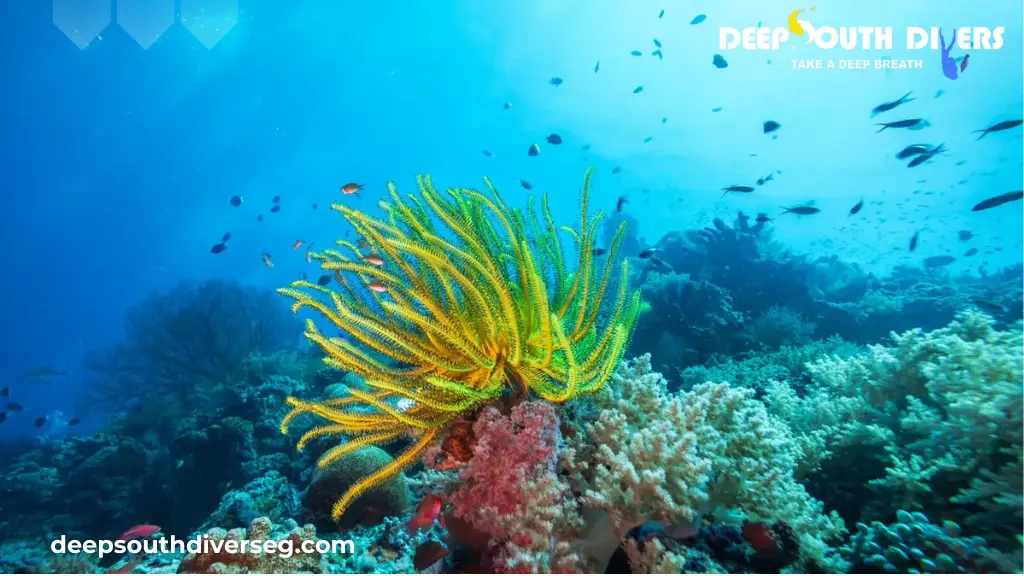
- Soft corals — order Alcyonacea. These do not build massive limestone skeletons; instead they have a flexible structure stiffened by tiny spiny elements, and they sway in the current. The Red Sea is globally famous for its soft coral, especially its pulsing, candy-coloured Dendronephthya.
The zooxanthellae partnership
The secret engine of the reef is a partnership. Inside coral tissue live single-celled algae called zooxanthellae. Through photosynthesis these algae supply the coral with up to 90% of its energy, and in return the coral gives them shelter and nutrients. The algae also give coral its colour. This is why reef-building corals need clear, shallow, sunlit water — and why, when stress forces the coral to expel its algae, it turns ghostly white. That is coral bleaching, and we return to it below.
How corals feed
Photosynthesis is only half the story. At night, many corals extend stinging tentacles to capture drifting zooplankton, and occasionally tiny fish. Soft corals that host fewer algae often thrive in nutrient-rich, current-swept, lower-light spots precisely because they rely more on this filter-feeding.
How a Coral Reef Forms in the Red Sea
A coral reef is not built in a human lifetime. It is the slow accumulation of countless generations of limestone skeletons, layered one upon another across millennia.
From larva to colony
Reproduction begins when corals release larvae or gametes — eggs and sperm — into the water. After fertilisation, a free-swimming larva drifts until it finds a firm, shallow, sunlit surface to settle on. Once anchored, it becomes the founding polyp of a brand-new colony, dividing again and again to grow. Some species are hermaphroditic; others have separate male and female colonies.
Centuries of growth
Colonies expand outward and upward, merging with neighbours. Over hundreds to thousands of years these merging colonies form the reef structure itself; some Red Sea reefs began forming around 50 million years ago, and individual reef systems can eventually build up enough to create islands. Crucially, a thriving reef depends on a balanced community — herbivores such as sea urchins and grazing fish that keep smothering macroalgae in check, allowing coral to compete for space on the seabed.
Why the Red Sea is ideal for reef building
Several factors converge to make this one of the planet’s best reef habitats:
- Exceptional water clarity — minimal freshwater and river input, plus sediment trapped by the sea’s great depth, keeps the water gin-clear so sunlight reaches the algae.
- Stable temperature and salinity — limited water exchange with the Indian Ocean buffers extremes.
- Calm conditions — the lack of severe storms means coral growth is far less restricted by wave damage than on exposed oceanic reefs.
Geography of the Coral Reef Red Sea System
The Red Sea is a long, narrow body of water stretching roughly 2,100 km, with a central trough plunging beyond 2,000 metres deep. Its reefs are not uniform; they change character dramatically from north to south, and understanding this geography helps you choose where to dive.
The Great Fringing Reef
The signature feature is the Great Fringing Reef of the Egyptian Red Sea, which extends more than 2,000 km along the Gulfs of Aqaba and Suez, the mainland Red Sea coast, and the fringing reefs around some 44 islands. Roughly half of this fringing reef already lies inside declared protected areas — including Ras Mohammed, Nabq and Abu Galum in the north, and the Northern Islands, Wadi El Gemal and Gebel Elba protected areas further south — while around half still awaits formal protection.
The Gulf of Aqaba (Gulf of Eilat)
Deep, reaching about 2,000 metres, the Gulf of Aqaba is characterised by narrow fringing reefs and dramatic vertical drop-offs. It also holds the greatest coral diversity in the region and has become the scientific epicentre of “super coral” research.
The Gulf of Suez
By contrast the Gulf of Suez is wide and shallow — no deeper than around 85 metres — dominated by sand and sediment, with comparatively few corals and only discontinuous, fragmented fringing and patch reefs.
The central and southern Red Sea
South of the gulfs, extensive continuous fringing reefs run all the way down toward the Sudanese border. Offshore, reef complexes sit on narrow underwater banks of tectonic origin a few kilometres from shore, producing the legendary coral gardens, canyons and pinnacles of the deep south. The southern coast alone holds over 250 km of fringing reef, frequently broken by the small bays known locally as marsas and sharms, and backed by wide reef flats that sometimes form sheltered lagoons suitable for swimming, wading or kitesurfing. Diversity does, however, decline toward the far south, where shallower water, higher turbidity and more freshwater input reduce reef complexity.
Reef types you will encounter
- Fringing reefs — growing directly off the shoreline; the dominant Red Sea type.
- Patch and bank reefs — isolated offshore outcrops rising from deeper water.
- Atoll-like and barrier structures — found around the southern archipelagos such as the Dahlak and Farasan groups.
- Pinnacles and ergs — tower-like coral heads beloved by photographers.
Biodiversity: The Marine Life of the Red Sea Coral Reef
The coral reef Red Sea ecosystem ranks among the world’s most important repositories of marine biodiversity, and a striking share of its inhabitants are endemic — found nowhere else on the planet.
Coral diversity
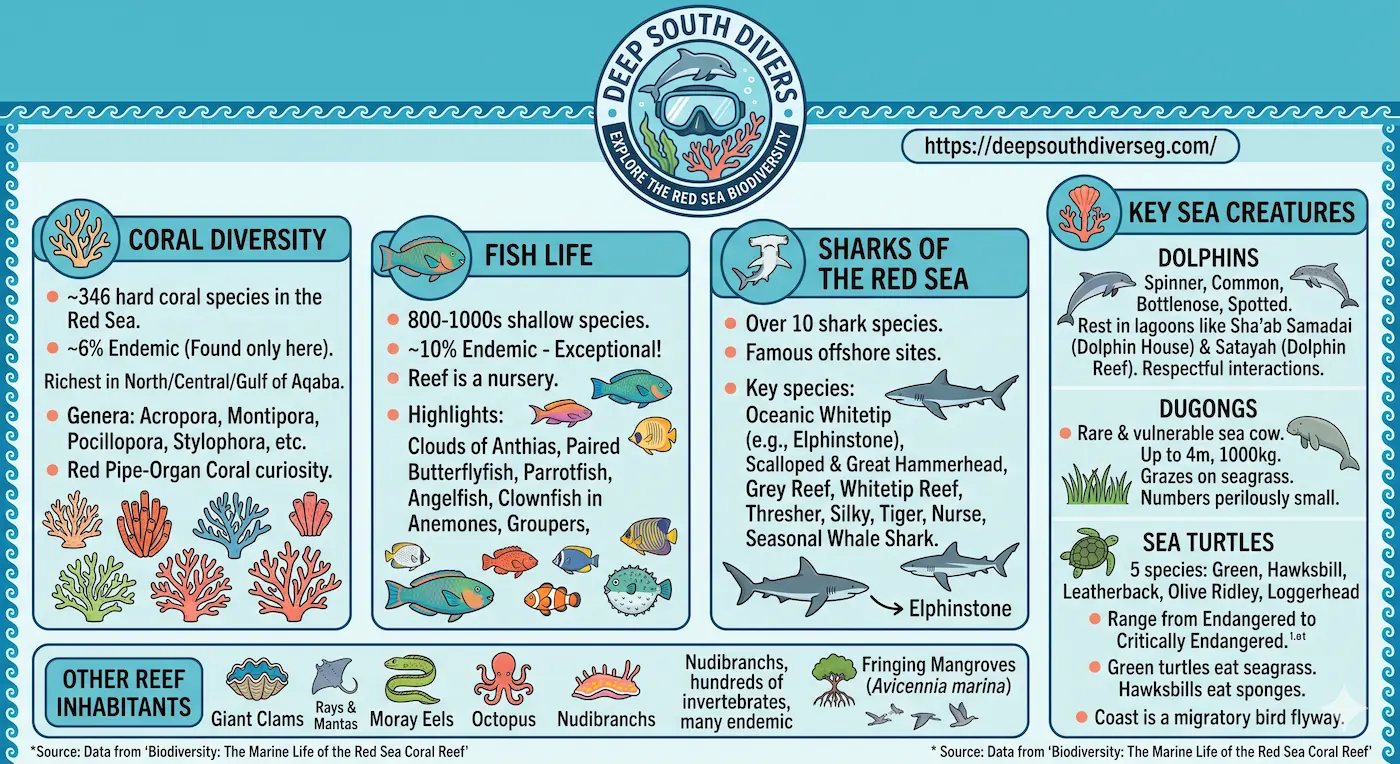
There are approximately 346 species of hard coral in the Red Sea, of which around 6% are endemic. Diversity is richest in the Gulf of Aqaba and the northern and central Red Sea — nearly double that of the south. Dominant stony-coral genera include Acropora, Montipora, Pocillopora, Stylophora, Pavona, Leptoseris, Fungia, Porites, Favia and Leptastrea, alongside curiosities like the red pipe-organ coral (Tubipora musica).
Fish life
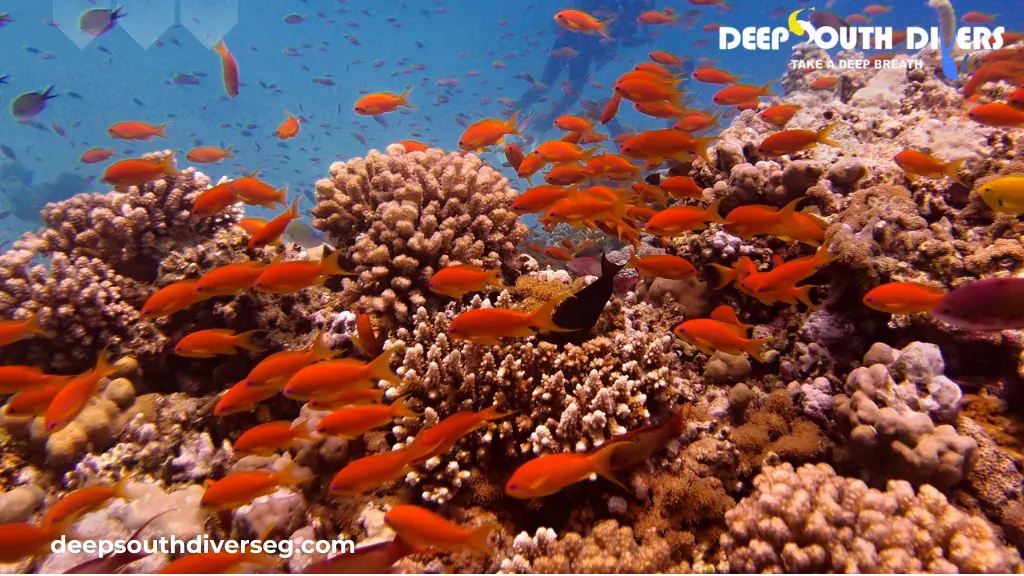
Estimates of reef fish run from roughly 800 shallow species up into the 1,000s when the wider basin is counted, with about 10% endemic — an exceptional level. Expect clouds of orange anthias, paired butterflyfish, parrotfish crunching coral, angelfish, clownfish nestled in anemones, groupers, Napoleon wrasse and the ever-curious pufferfish. The reef’s structure is a nursery, allowing juveniles to grow into adulthood in relative safety.
Sharks of the Red Sea
More than ten shark species patrol these waters, and certain offshore sites are world-renowned for encounters. They include:
- Oceanic whitetip (famous at Elphinstone)
- Scalloped and great hammerhead
- Grey reef and whitetip reef shark
- Thresher, silky and tiger shark
- Nurse shark and the seasonal whale shark
The economic logic of protecting them is stark: a single living shark has been estimated to generate around US$120,000 in tourism revenue per year, far more than it would ever fetch dead.
Dolphins
Eight dolphin species are considered regular Red Sea residents, among them spinner, common and Indo-Pacific bottlenose, and pantropical spotted dolphins. Spinner dolphins famously rest by day in sheltered lagoons such as Sha’ab Samadai (Dolphin House) and Satayah (Dolphin Reef), where calm, respectful swimmers may be approached by curious pods.
Swimming with dolphins responsibly in Egypt
Dugongs — the vanishing sea cow
Perhaps the most prized sighting of all is the dugong, a gentle, seagrass-grazing marine mammal that can reach four metres and 1,000 kilograms. The species is listed as vulnerable on the IUCN Red List, and numbers along the southern Egyptian coast are perilously small. Their fate is tied directly to the health of seagrass beds, which tourism development and pollution increasingly threaten.
Sea turtles
Five sea turtle species occur in the Egyptian Red Sea — green, hawksbill, leatherback, olive ridley and the rare loggerhead — ranging from endangered to critically endangered. Two play outsized ecological roles: green turtles graze and maintain healthy seagrass beds, while hawksbills feed on sponges and corals, balancing the competition between them. Protecting turtles, in other words, means protecting the entire reef.
Other reef inhabitants
Beyond the headline species, the reef teems with giant clams (Tridacna maxima), rays and mantas, moray eels, octopus, nudibranchs, and hundreds of echinoderm, mollusc and crustacean species, many endemic. Fringing mangroves — chiefly the grey mangrove (Avicennia marina) — and the coast’s role as a migratory bird flyway round out an ecosystem of remarkable completeness.
The “Super Corals” of the Red Sea: Why Scientists Are Watching
This is the part of the coral reef Red Sea story that has captured global scientific attention, and it deserves a careful, accurate explanation rather than hype.
The thermal-tolerance phenomenon
For most corals worldwide, a sustained temperature rise of just 1°C above the local summer maximum is enough to trigger bleaching. Research published around 2020 found that certain northern Red Sea and Gulf of Aqaba corals could tolerate increases on the order of several degrees — figures as high as a 7°C rise have been cited — without bleaching. Scientists nicknamed them “super corals.”
Why are Red Sea corals so resilient?
The leading explanation is evolutionary history. To colonise the Red Sea, coral larvae historically had to pass through the warmer southern entrance at the Bab-el-Mandeb strait, effectively pre-selecting heat-hardy genotypes that then settled in the cooler north. The result is a population living well below its thermal threshold — a built-in safety margin that most of the world’s reefs lack.
A potential global refuge
The implications are profound. Organisations such as HEPCA argue that the Great Fringing Reef may not only survive committed warming but could help repopulate damaged reefs elsewhere over time. In their framing, these reefs are a symbol of hope and a chance to avoid pushing entire ecosystems past “nature’s tipping point.”
An important caution
Resilience is not invincibility. By late 2023 and into 2024, bleaching events were increasingly reported in the Red Sea, including the once-spared Gulf of Aqaba. Thermal tolerance also does nothing to protect corals from local pressures — pollution, sedimentation, disease and physical damage. The “super coral” refuge only holds if both global warming is limited and local protection is enforced.
Threats Facing the Coral Reef Red Sea Ecosystem
The once-pristine reefs of the Red Sea are, in many areas, in measurable decline. A widely cited figure records a 20–30% drop in coral cover between 1987 and 1996, largely attributed to rapidly expanding tourism. Understanding the threats is the first step to reversing them.
Climate change and bleaching
Even resilient reefs are vulnerable as marine heatwaves intensify. When water warms beyond tolerance, corals expel their zooxanthellae, lose colour, and — if stress persists — starve and die.
Tourism and diver impact
Careless fins, hands on coral, stirred-up sediment, and trampling in shallows cause cumulative, localised damage. Anchors dropped onto reefs are especially destructive, flattening structures that took centuries to build.
Coastal development and pollution
Sewage and nutrient runoff from hotels and resorts, sedimentation from dredging and construction of artificial beaches, desalination brine, oil spills, and heavy boat and tanker traffic all degrade water quality — and corals cannot tolerate murky, sediment-laden water that clogs their polyps.
Disease and biological pressures
White band disease, predatory Drupella snails and outbreaks of the coral-eating crown-of-thorns starfish all take a toll, as can population explosions of the black-spined urchin Diadema setosum, which can damage coral and its juvenile spat.
Overfishing
Removing top predators or key herbivores unbalances the whole system. Lose the grazers and algae smother the coral; lose the predators and prey species explode. Spearfishing, destructive fishing and bycatch compound the problem.
| Threat | Primary Cause | Effect on Reef | Reversibility |
|---|---|---|---|
| Bleaching | Rising sea temperature | Coral starvation & death | Possible if brief |
| Diver/anchor damage | Tourism & boating | Physical breakage | Slow (decades) |
| Pollution & sediment | Development, sewage, dredging | Clogged polyps, poor growth | Moderate |
| Disease & predators | Drupella, crown-of-thorns, urchins | Tissue loss, mortality | Variable |
| Overfishing | Loss of grazers/predators | Algal overgrowth, imbalance | Moderate if managed |
Conservation: Protecting the Red Sea Coral Reef
The encouraging news is that the Red Sea hosts some of the world’s most active and innovative reef-conservation work, and visitors are part of the solution.
Marine protected areas and mooring systems
National parks such as Ras Mohammed, Wadi El Gemal and the offshore island reserves shield large reef areas, while fixed mooring-buoy systems let dive boats tie up without dropping anchors onto living coral — a simple intervention with outsized benefits.
Monitoring and research
Programmes like Bleach Watch Egypt track the timing and severity of bleaching, while international bodies such as the Transnational Red Sea Center and regional organisations coordinate science across borders. Reef Check surveys and citizen-science turtle and dolphin monitoring add valuable long-term data.
Sustainable dive operations
Operators adopting initiatives such as Green Fins best-practice guidelines, house-reef protection, waste and water management, and diver briefings on buoyancy and contact are setting the standard for low-impact tourism.
What you can do as a visitor
- Master neutral buoyancy before diving over coral — consider a buoyancy specialty course.
- Never touch, stand on, kneel on or collect coral, shells or marine life.
- Use only reef-safe sunscreen, or cover up with a rash vest instead.
- Choose operators that use mooring buoys and follow recognised eco-standards.
- Keep a respectful distance from turtles, dolphins and dugongs — observe, never chase.
- Take all rubbish away with you and report reef violations to local authorities.
Where to Experience the Coral Reef Red Sea
From shore-entry house reefs to bucket-list offshore walls, the region caters to every level. A few standouts:
- Ras Mohammed (Sharm El Sheikh) — iconic walls and Shark & Yolanda reefs.
- Elphinstone Reef (Marsa Alam) — dramatic drop-offs and oceanic whitetip encounters for experienced divers.
- Sha’ab Samadai / Dolphin House — a protected lagoon for snorkelling with spinner dolphins.
- The Brothers, Daedalus and the Deep South (St John’s, Fury Shoals) — liveaboard territory with pristine coral and big pelagics.
- Hurghada and northern house reefs — accessible reefs ideal for first-timers and courses.
- Marsa Shagra, Marsa Nakari and Wadi Lahami — eco-camps offering unlimited shore diving on healthy southern fringing reef.
Marsa Alam, in particular, is famous for shore diving straight onto the reef, while Hurghada relies more on short boat hops.
Conclusion: A Reef Worth Protecting
The coral reef Red Sea ecosystem is more than a spectacular backdrop for a holiday photo. It is a 40-million-year-old living archive, a biodiversity stronghold, and — thanks to its heat-defying super corals — possibly one of the last great hopes for coral reefs in a warming world. From the deep walls of the Gulf of Aqaba to the sun-drenched fringing reefs of the south, it rewards everyone who visits with encounters they will never forget: a turtle gliding over seagrass, a wall ablaze with soft coral, a pod of spinner dolphins materialising out of the blue.
But hope is not a guarantee. These reefs will only continue to thrive if global warming is curbed and local protection is taken seriously, and that responsibility extends to every diver, snorkeller and traveller who enters the water. Tread lightly, choose wisely, and the Red Sea coral reef will still be astonishing generations from now.
This article reflects first-hand diving experience combined with published reef science and the work of regional conservation bodies. Reef conditions and bleaching status change over time; consult current local monitoring and operators before you travel.