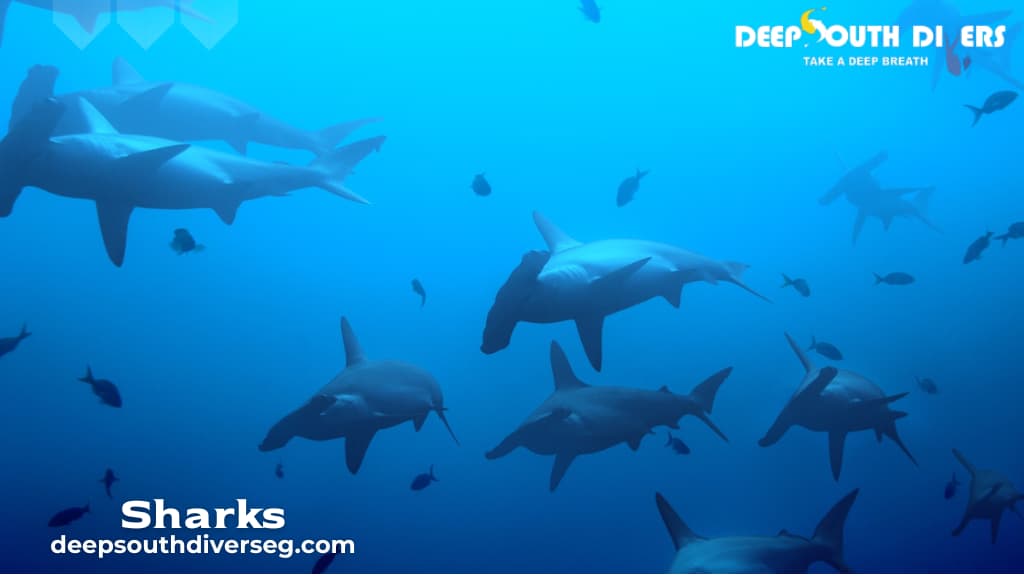
Marsa Alam is one of the few places in the world where divers can regularly encounter sharks in crystal-clear waters. Common species include the Oceanic Whitetip Shark, Scalloped Hammerhead, Grey Reef Shark, and occasionally the Silky Shark. These species thrive in the deep offshore reefs of the southern Red Sea, drawn by nutrient-rich currents and healthy coral ecosystems.
Elphinstone Reef: The Home of the Oceanic Whitetip
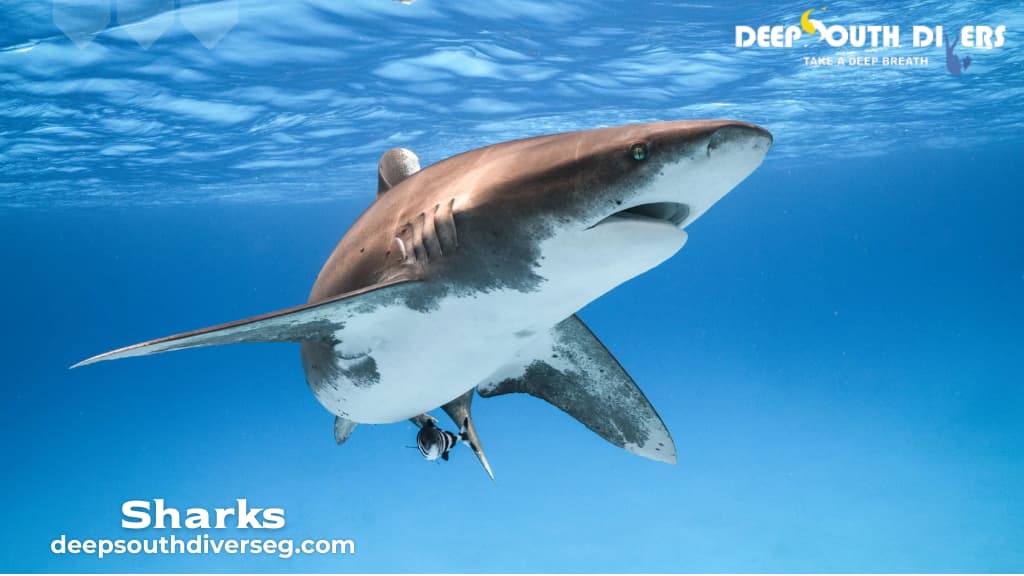
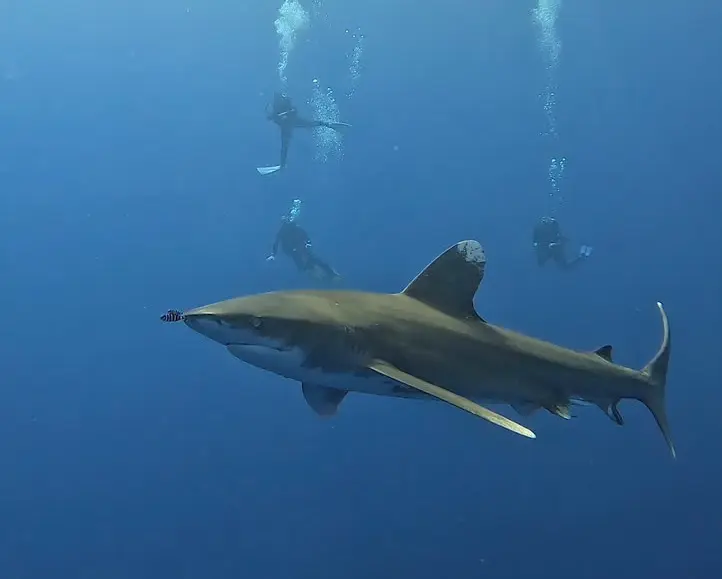
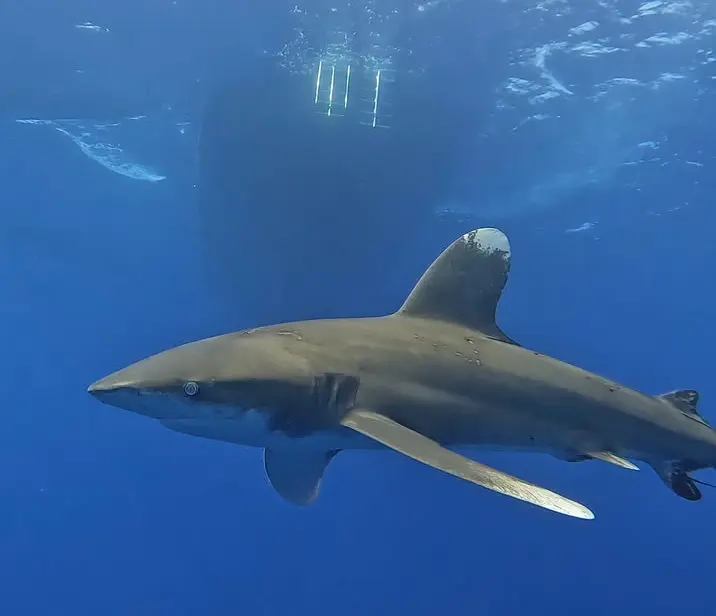
Elphinstone Reef is world-famous for sightings of the Oceanic Whitetip Shark (Carcharhinus longimanus), one of the most iconic species in the Red Sea. This deep, narrow reef rises dramatically from the depths and offers a thrilling drift dive for advanced divers. Encounters here are often close and unforgettable, as the sharks circle curiously in the blue.
Diving Daedalus Reef: In Search of Scalloped Hammerheads
Located about 80 km offshore, Daedalus Reef is a diver’s dream destination. It’s one of the few places where large schools of Scalloped Hammerhead Sharks (Sphyrna lewini) can be seen, especially between May and October. The sheer walls and open ocean exposure make Daedalus ideal for pelagic encounters — a must-visit for shark enthusiasts.
Are Marsa Alam Sharks Dangerous? Debunking the Myths
Despite their fearsome reputation, sharks in Marsa Alam are not dangerous when treated with respect. They are naturally cautious animals, and aggressive behavior is extremely rare. Most incidents occur due to misunderstanding or provocation. At Deep South Divers, safety briefings always include proper shark behavior awareness to ensure a respectful and secure experience.
Essential Safety Rules for Diving with Sharks
To enjoy your shark dive safely, always:
- Stay calm and move slowly — sudden movements can startle sharks.
- Maintain eye contact and face the animal.
- Stay close to your dive group and follow your guide’s instructions.
- Do not chase or corner any shark.
- Avoid wearing shiny gear that may reflect light underwater.
How to Behave During a Shark Encounter
When you see a shark, remain still and observe its behavior. Most sharks will simply pass by, curious but uninterested. If it comes closer, maintain a vertical posture, avoid turning your back, and gently adjust your position to keep it in sight. Remember — calm divers make calm sharks.
Respect, Don’t Touch: Ethical Shark Diving Practices
Sharks are vital to the Red Sea ecosystem. At Deep South Divers, we promote responsible diving ethics:
- Never feed or touch marine life.
- Keep a respectful distance for both your safety and the shark’s comfort.
- Support eco-conscious operators who follow local conservation guidelines.
By diving responsibly, you help protect these incredible animals for future generations.
Beyond the “Big Two”: Other Sharks You Might See
While Oceanic Whitetips and Hammerheads steal the spotlight, Marsa Alam is also home to other fascinating species like the Thresher Shark, Silky Shark, Blacktip Reef Shark, and occasionally the Tiger Shark. Each species has its own preferred depth and behavior, making every dive a unique adventure.
Best Time of Year for Shark Sightings in Marsa Alam
The shark season in Marsa Alam typically runs from May to November, when water temperatures rise and currents attract pelagic life. Hammerheads are most frequent at Daedalus during summer, while Oceanic Whitetips are seen at Elphinstone from October to December.
Choosing Your Shark Dive: What Deep South Divers Offers
At Deep South Divers, we organize guided shark diving trips to Elphinstone, Daedalus, and other top Red Sea reefs. Our expert dive masters ensure safe encounters, proper briefings, and unforgettable underwater memories. Whether you’re an advanced diver chasing pelagics or a beginner hoping for your first shark sighting, we tailor every dive to your comfort level.
Join Deep South Divers in Marsa Alam and experience the thrill of swimming alongside some of the ocean’s most graceful predators — safely, ethically, and responsibly.
What Sharks Are in the Red Sea? A Complete Marsa Alam Species Guide
Divers who ask what sharks are in the Red Sea are usually surprised by the answer. This narrow, hypersaline, semi-enclosed sea holds a shark community far richer than its size suggests — well over a dozen species have been reliably documented in Egyptian waters, and the southern reefs off Marsa Alam host more of them, more consistently, than anywhere else along the coast. After two decades of guiding offshore dives here, our team has logged encounters with every species on the list below, some of them hundreds of times, a handful only once or twice.
What makes the Red Sea unusual is the compression of habitats. A reef top sitting in five metres of water can drop to eight hundred metres within a fin-kick of the wall. That means reef-dwelling species and true open-ocean pelagics occupy adjacent water columns, and a single dive at a site like Elphinstone can put a grey reef shark on your left shoulder and an oceanic whitetip in the blue above your head. Very few dive destinations on earth offer that vertical range from a day boat.
The species below are organised by how likely you are to actually encounter them while diving in the Marsa Alam region — not by how famous they are. It is worth remembering that “common” is a relative term here. Global shark populations have contracted sharply over the last half-century, and several of the species listed carry a threatened status on the IUCN Red List. A sighting is a privilege, not an entitlement.
The Reef Residents You’ll See Most Often
These are the sharks of the coral structure itself — the ones patrolling drop-offs, resting in sand channels, and quietly ignoring divers. If you dive Marsa Alam for a week, you will very probably meet at least one.
- Grey reef shark (Carcharhinus amblyrhynchos) — Reaching roughly two metres, this is the most frequently observed shark in Egypt’s Red Sea. Look for the broad black margin on the trailing edge of the tail fin. Grey reefs are curious but wary; they will make a slow pass and continue. They favour reef edges and current-swept plateaus and are present year-round, with better encounter rates on offshore reefs than on coastal house reefs.
- Whitetip reef shark (Triaenodon obesus) — A slender, brown, cat-eyed shark that spends the day motionless under coral overhangs and in crevices, hunting at night. The bright white tips on the dorsal and caudal fins are unmistakable. Unlike most requiem sharks, it can pump water over its gills while stationary. Reliable year-round at Elphinstone, Fury Shoal and St. John’s Reef.
- Blacktip reef shark (Carcharhinus melanopterus) — Shallow-water specialists, often seen in the first few metres over sandy reef flats. Sharply defined black fin tips. They are notably timid and will usually leave before you get close. Summer months bring the best chances.
The Pelagic Headliners
These are the sharks people fly to Egypt for. All of them are open-ocean animals that visit reefs — which means encounters depend on the reef being offshore, deep-flanked, and current-exposed. This is exactly why the Elphinstone Reef dive site and Daedalus dominate any conversation about Marsa Alam sharks.
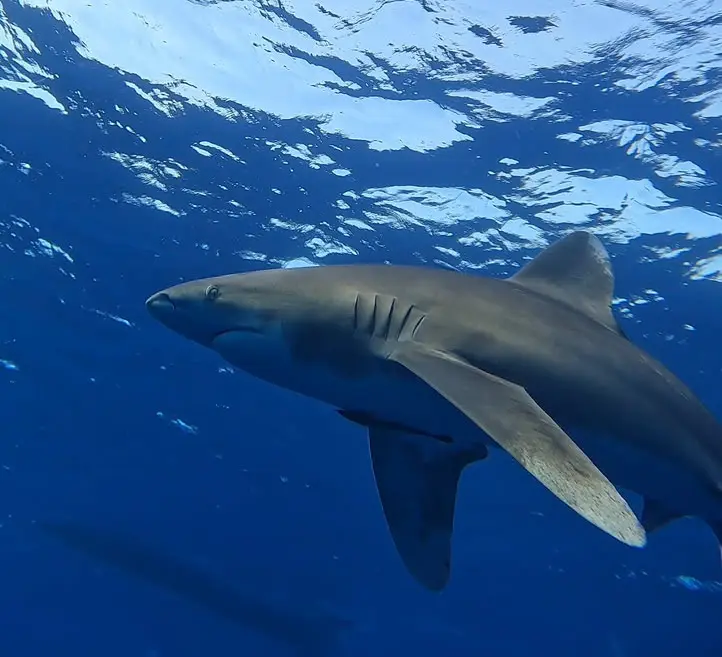
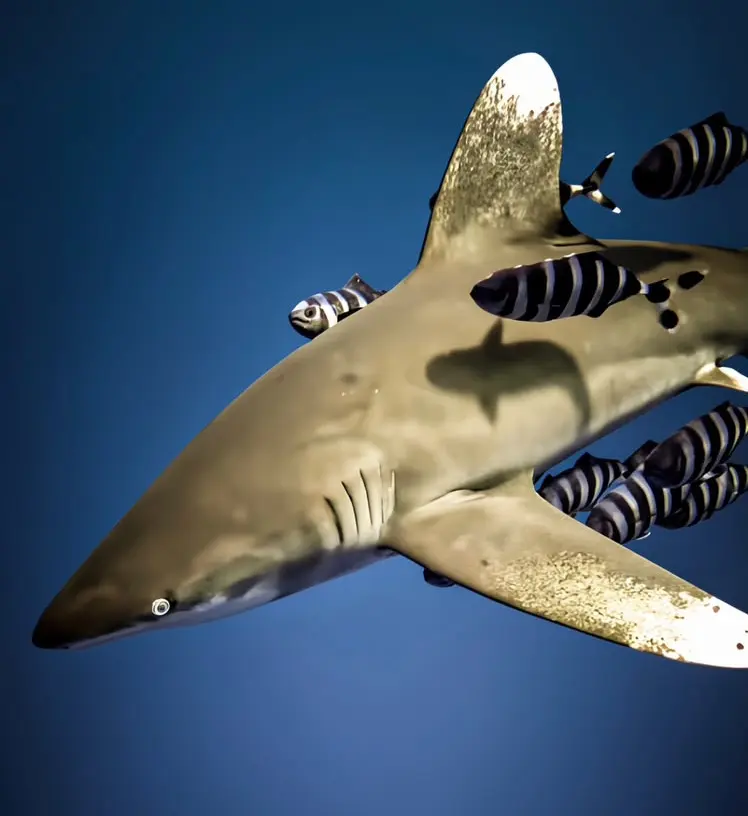
- Oceanic whitetip shark (Carcharhinus longimanus) — Up to about 3.5 metres, with unmistakable rounded, paddle-shaped fins mottled white at the tips. Classified as Vulnerable globally. Its defining trait is confidence: it approaches slowly, deliberately, and without apparent fear, often accompanied by pilot fish. Peak season runs autumn into early winter, though sightings occur outside that window.
- Scalloped hammerhead (Sphyrna lewini) — The species that draws divers to Daedalus. Listed as Endangered. Schooling behaviour, sometimes in groups of dozens, occurs in deeper water during summer mornings. Shy of exhaust bubbles, which is why still, slow, controlled diving dramatically improves your odds.
- Silky shark (Carcharhinus falciformis) — Streamlined, smooth-skinned, and around three metres. A genuinely open-ocean animal that sometimes shoals near offshore reefs in late spring. Alternately shy and remarkably inquisitive, occasionally shadowing divers during safety stops.
- Silvertip shark (Carcharhinus albimarginatus) — Larger and considerably bolder than the grey reef it superficially resembles, distinguished by brilliant white margins on every fin. Once regular at the southern offshore reefs, now an uncommon and prized sighting.
The Gentle Giants and Bottom-Dwellers
Not every shark in the Red Sea is a predator in the cinematic sense. Several of the most memorable encounters involve animals that pose no plausible threat whatsoever.
- Whale shark (Rhincodon typus) — The largest fish alive, filter-feeding on plankton and small fish. Vulnerable on the IUCN Red List. Sightings cluster in warmer months when plankton density rises, typically near the surface and often at Elphinstone or Daedalus. Never approach head-on and never touch; keep well clear of the tail.
- Zebra shark (Stegostoma tigrinum), also called the leopard shark — Long-tailed, spotted as an adult (striped only as a juvenile, hence the confusing name). A nocturnal bottom-dweller, most often found resting on sand near reef bases.
- Tawny nurse shark (Nebrius ferrugineus) — Broad-headed, barbelled, and slow. Sleeps in caves and under ledges by day. Harmless if left undisturbed.
Rare and Occasional Visitors
Some species exist in Red Sea waters but reveal themselves only occasionally. Reporting them honestly matters — inflated expectations do divers no favours.
- Tiger shark (Galeocerdo cuvier) — Large, up to five metres or more, with faded vertical bars on the flanks. Usually deep or offshore; sightings at Rocky Island and, rarely, Elphinstone. Generally shy underwater but capable of bold curiosity. Always warrants heightened awareness.
- Shortfin mako (Isurus oxyrinchus) — A pointed-snouted, metallic-blue speedster and the fastest shark in the ocean, capable of brief bursts well above 60 km/h thanks to regional endothermy, drag-reducing dermal denticles, and a torpedo profile. Deep-water; rarely seen on recreational dives.
- Common thresher shark (Alopias vulpinus) — Instantly identified by a caudal fin as long as its body, used to stun schooling prey. A deep, cool-water species; a distant silhouette at Daedalus or the Brothers is the realistic best case.
- Bignose shark (Carcharhinus altimus) — Confirmed in the Red Sea, deep-dwelling, and effectively never encountered by recreational divers.
Red Sea Shark Species at a Glance
| Species | Scientific Name | Max Length | IUCN Status | Typical Habitat | Encounter Likelihood (Marsa Alam) |
|---|---|---|---|---|---|
| Grey reef shark | Carcharhinus amblyrhynchos | 2.0 m | Near Threatened | Reef edges, plateaus | High |
| Whitetip reef shark | Triaenodon obesus | 2.0 m | Near Threatened | Caves, crevices | High |
| Blacktip reef shark | Carcharhinus melanopterus | 1.8 m | Vulnerable | Shallow reef flats | Moderate |
| Oceanic whitetip | Carcharhinus longimanus | 3.5 m | Vulnerable | Open water near offshore reefs | Moderate–High (autumn) |
| Scalloped hammerhead | Sphyrna lewini | 3.5 m | Endangered | Deep water, offshore | Moderate (summer, Daedalus) |
| Silky shark | Carcharhinus falciformis | 3.3 m | Vulnerable | Open water | Low–Moderate (spring) |
| Silvertip shark | Carcharhinus albimarginatus | 3.0 m | Vulnerable | Offshore reefs, islands | Low |
| Whale shark | Rhincodon typus | 12.0 m | Endangered | Surface, plankton-rich water | Low (seasonal) |
| Zebra (leopard) shark | Stegostoma tigrinum | 2.5 m | Endangered | Sand near reef | Low |
| Tawny nurse shark | Nebrius ferrugineus | 3.2 m | Vulnerable | Caves, seabed | Low |
| Tiger shark | Galeocerdo cuvier | 5.5 m | Near Threatened | Deep, offshore | Rare |
| Shortfin mako | Isurus oxyrinchus | 4.0 m | Endangered | Deep, pelagic | Very rare |
| Common thresher | Alopias vulpinus | 5.5 m | Vulnerable | Deep, cool water | Very rare |
Conservation statuses reflect IUCN Red List global assessments and should be treated as indicative; regional Red Sea populations may face different pressures.
Where to See Hammerhead Sharks in Egypt: The Definitive Site Guide
Of all the questions we field at the dive centre, where to see hammerhead sharks in Egypt is the one asked most often and answered worst online. The honest answer has three parts: a small number of specific reefs, a narrow seasonal window, and a diving style that most people have to consciously learn. Get all three right and your odds are genuinely good. Get one wrong and you will spend a week staring into empty blue.
Scalloped hammerheads congregate around isolated offshore seamounts and reefs where upwelling concentrates prey and where cleaner wrasse stations attract them into diveable depths. Egypt has a handful of such places, and Marsa Alam sits closer to the best of them than any other resort town on the coast. That geographical accident is the single reason this region has become Egypt’s hammerhead hub.
One technique note that matters more than any site choice: hammerheads are acutely sensitive to bubble noise. The divers who see schools are the ones who descend early, hold a steady depth on the plateau edge, breathe long and slow, and resist the instinct to swim toward the animals. Chasing a school guarantees you will watch it dissolve into the blue.
Daedalus Reef — Egypt’s Hammerhead Capital
Roughly eighty kilometres offshore, Daedalus is an isolated pinnacle surrounded by hundreds of metres of open water — an oasis in a desert of blue. Its northern plateau is the classic hammerhead station, dived at first light when the schools rise from the deep to be cleaned. Groups of fifteen to fifty animals have been recorded here, typically between late spring and midsummer.
Daedalus is reachable only by liveaboard. The reef is exposed, the currents can be substantial, and there is no shelter and no shore. It rewards experienced divers and punishes overconfident ones. Our Daedalus Reef diving trips place hammerhead-priority dives in the first slot of the day for exactly this reason.
The Brothers Islands and St. John’s Plateau
The Brothers — Big Brother and Small Brother — sit around sixty to seventy kilometres offshore between Hurghada and Marsa Alam, and produce hammerhead sightings alongside thresher and grey reef sharks. Big Brother also holds the SS Numidia wreck, making it a rare site where a hammerhead pass and a nineteenth-century steamer can occupy the same dive.
Far to the south, the St. John’s Reef complex and its plateau offer hammerhead encounters in a wilder, less-visited setting, along with Rocky Island and Zabargad. All of these are liveaboard-only propositions from Marsa Alam or Port Ghalib.
Elphinstone and Sho’ab Sharm: The Day-Boat Option
If a week-long liveaboard isn’t feasible, hammerheads do appear at Elphinstone — twelve to twenty kilometres offshore and within speedboat range — most often as solitary animals or small groups patrolling deep along the southern plateau. Sho’ab Sharm, inside the Wadi El Gemal National Park zone, is a second day-boat possibility when sea conditions cooperate.
Set expectations accordingly. A day boat gives you two dives at a site where hammerheads are a bonus, not a headline. A liveaboard to Daedalus gives you four dives a day at a site where they are the main event. Both are valid; they are not equivalent.
Hammerhead Sightings by Site and Season
| Site | Distance from Marsa Alam | Access | Peak Hammerhead Window | Schooling Likely? |
|---|---|---|---|---|
| Daedalus Reef | ~80 km | Liveaboard only | May – July | Yes — large schools |
| Brothers Islands | ~60–70 km | Liveaboard only | May – July | Occasionally |
| St. John’s Plateau | Deep south | Liveaboard only | May – August | Occasionally |
| Elphinstone Reef | ~12–20 km | Day boat / speedboat | June – September | Rarely — usually solitary |
| Sho’ab Sharm | Wadi El Gemal zone | Day boat (weather dependent) | June – September | Rarely |
| Jackson Reef (Sinai) | Straits of Tiran | Day boat from Sharm | July – September | Yes |
Beyond Elphinstone and Daedalus: Other Marsa Alam Shark Dive Sites
The two headline reefs monopolise the conversation, but the southern Red Sea has a deeper bench. Understanding which sites are reachable in a morning and which demand a week aboard a boat is the most practical piece of planning knowledge you can carry into a shark-diving trip.
Day Boat and Speedboat Sites
- Elphinstone Reef — The benchmark. Long north and south plateaus, sheer walls, and the most consistent oceanic whitetip encounters in Egypt.
- Sho’ab Sharm — Inside Wadi El Gemal National Park. Reef sharks reliably; occasional pelagics.
- Marsa Alam house reefs and bays — Whitetip reef sharks resting under coral heads; a low-pressure introduction to shark encounters for newer divers. See our Marsa Alam dive sites overview.
- Shaab Marsa Alam and Abu Dabbab — Reef sharks alongside turtles, dugongs and guitarfish.
Liveaboard-Only Sites
- Daedalus Reef — Hammerhead schools, oceanic whitetips, occasional threshers.
- Brothers Islands — Pelagics plus the SS Numidia and Aida wrecks.
- Fury Shoal — Extensive reef system; whitetip and blacktip reef sharks, occasional silvertips.
- St. John’s Reef — Grey reef sharks in numbers; hammerheads and oceanic whitetips seasonally.
- Rocky Island and Zabargad — Egypt’s most remote diving; the realistic tiger shark territory.
- Sataya Reef — Better known for spinner dolphins, but reef sharks patrol the outer walls.
Certification and Experience: Are You Ready for a Shark Dive?
Offshore shark diving in Marsa Alam is not an activity you drift into on holiday. The reefs that hold pelagic sharks are the reefs with the strongest currents, the deepest walls, and the fewest exits. Negative entries, blue-water descents, mid-water safety stops with no reference, and the possibility of a surface drift away from the boat are all standard rather than exceptional. Every one of those demands competence acquired beforehand, not improvised at forty metres.
We would rather tell an honest “not yet” than sell an unsafe dive. That principle costs us bookings and has never once cost us a diver.
Minimum Requirements for Offshore Shark Diving
- Advanced Open Water certification (PADI, SSI, or equivalent) — non-negotiable for Elphinstone and Daedalus.
- A minimum of 50 logged dives, with recent experience — a certification card from six years ago is not currency.
- Demonstrated buoyancy control, particularly the ability to hold a mid-water stop without a reference line.
- Competence in moderate to strong current, including drift diving and negative entry.
- Independent SMB deployment from depth. On an offshore reef this is a genuine safety instrument, not a formality.
- A dive within the last twelve months, or a refresher session before the trip.
Recommended Specialties
- Deep Diver — Hammerheads frequently appear below thirty metres. Without depth training and gas planning, the encounter is either missed or unsafe.
- Enriched Air (Nitrox) — Extends bottom time in the exact depth band where pelagic encounters occur.
- Drift Diving — The default condition at Elphinstone.
- Peak Performance Buoyancy — The single skill that most improves shark encounters, because it makes you still and quiet.
If you fall short of any of these, the fix is straightforward and often takes less than a week. Our Advanced Open Water course in Marsa Alam and Nitrox certification are routinely completed on the front end of a shark-diving holiday, and divers who do so consistently report better encounters — not merely safer ones.
How Risky Is Shark Diving in Marsa Alam? The Numbers, Honestly
A responsible dive centre does not tell you sharks are harmless. It tells you what the evidence actually shows, and then explains what governs the difference between a safe encounter and an unsafe one. Sharks are large wild predators. Treating them as either monsters or pets is equally inaccurate and equally dangerous.
Serious shark incidents have occurred along Egypt’s Red Sea coast. They are documented, they have taken lives, and they deserve to be discussed with sobriety rather than either sensationalism or silence. Over roughly the last quarter-century, fewer than ten fatalities have been attributed to sharks across the entire Egyptian coastline, against many tens of millions of tourist water entries in the same period. The International Shark Attack File places Egypt’s all-time recorded unprovoked incident total in the low twenties — an order of magnitude below the United States or Australia.
Putting Shark Risk in Perspective
Of roughly 500 shark species worldwide, only about a dozen have ever been implicated in a serious human injury. Global shark-related fatalities average in the single digits annually. The comparison below, drawn from lifetime-risk figures compiled by the Florida Museum’s International Shark Attack File, is not intended to trivialise the incidents that have occurred — it is intended to calibrate proportion.
| Cause of Death | Approximate Lifetime Risk |
|---|---|
| Heart disease | 1 in 5 |
| Stroke | 1 in 24 |
| Falling | 1 in 218 |
| Drowning | 1 in 1,134 |
| Lightning strike | 1 in 79,746 |
| Fireworks | 1 in 340,733 |
| Shark attack | 1 in 3,748,067 |
Why Divers Face Lower Risk Than Snorkellers
This is the most underreported fact in the whole conversation, and it is the one that should shape your holiday planning. Review the documented Egyptian incidents and a pattern emerges immediately: the overwhelming majority involved people at the surface — swimmers and snorkellers — often in deep water beyond the reef line, sometimes separated from a group.
The reasons are behavioural rather than mysterious. A silhouetted figure splashing at the surface, seen from below against light, presents an ambiguous profile. A diver at fifteen metres, oriented vertically, breathing steadily, exhaling loudly, and moving with a group, presents no such ambiguity. Sharks investigate uncertainty; they avoid noise, mass and confidence.
Practically, this means: if you are snorkelling in Marsa Alam, stay inside the reef, stay above shallow structure, stay with people, and get out of deep blue water. If you are diving, stay off the surface at offshore sites, descend promptly, ascend along the reef rather than in open blue, and keep your group tight. Our snorkeling in Marsa Alam guidance covers surface safety in more depth.
What Actually Causes the Rare Incidents
Marine scientists and Egyptian authorities have converged on a small set of contributing factors, none of which involve sharks developing a taste for people:
- Provisioning and feeding — Deliberate hand-feeding by divers or operators teaches sharks to associate humans with food. Photographic evidence has linked individual, previously fed sharks to subsequent incidents. This is the strongest single causal thread in the record.
- Waste dumping — Food scraps and, historically, livestock carcasses discharged from vessels draw sharks inshore and reward them for approaching boats and beaches.
- Overfishing and prey depletion — Reduced natural prey pushes large sharks to investigate unfamiliar food sources and into unfamiliar water.
- Surface activity in deep water — Swimming beyond the reef, especially at dawn or dusk when visibility drops and shark activity peaks.
- Shifting distributions — Warming water and altered current regimes appear to be redistributing some populations northward, bringing species into contact with high-density tourist zones.
Every item on that list is human-caused and human-preventable. That is the actual message of the safety data, and it is why we refuse feeding, refuse baiting, and refuse to run oversized groups at pelagic sites.
Conservation Status: Which Marsa Alam Sharks Are at Risk?
Behind every good shark dive is an uncomfortable statistic. Roughly one third of all shark and ray species are now assessed as threatened with extinction, driven overwhelmingly by fishing pressure — targeted, incidental, and for the fin trade. The Red Sea is not exempt. Several of the species that make Marsa Alam famous carry serious conservation designations, and the scalloped hammerhead, the reason so many divers cross continents to reach Daedalus, is Endangered on the IUCN Red List and listed on CITES Appendix II.
Sharks are slow to mature, produce few young, and gestate for long periods. A hammerhead population that is fished down does not bounce back in a decade. Whatever a reef looks like today reflects decisions made twenty years ago, and whatever it looks like in 2046 is being decided now.
Their ecological role compounds the stakes. As apex and mesopredators, sharks regulate the abundance and behaviour of the species below them. Remove them and trophic cascades follow — herbivore populations shift, algal competition with coral intensifies, reef resilience declines. The healthy hard-coral cover that makes Marsa Alam’s diving exceptional is not separate from its shark population. It is downstream of it.
How Divers Contribute to Shark Protection
- Refuse operators who bait, feed, or chum. It is the most consequential choice you make, and it is made before you book, not underwater.
- Report sightings. Photo-identification programmes rely on diver-submitted images of dorsal fins and markings to track individuals and populations over time.
- Never touch, ride, chase, or block. Basic, and still routinely violated for the sake of a photograph.
- Decline shark products. Fin soup, shark cartilage supplements, squalene cosmetics, and “flake” on a menu all fund the same industry.
- Choose small groups. Six divers behind a guide see more sharks than twenty do, and disturb them less.
- Support marine protected areas such as Wadi El Gemal National Park by paying park fees willingly and diving within the rules.
Who Protects Red Sea Sharks?
A small network of organisations does the unglamorous work. The Red Sea Shark Trust, founded by marine biologist Dr. Elke Bojanowski, has built the longest-running photo-identification database of Egyptian oceanic whitetips and grey reef sharks — much of it from images contributed by recreational divers. HEPCA operates mooring, monitoring and conservation programmes along the southern coast. The Chamber of Diving and Watersports (CDWS) sets operational standards for Egyptian dive centres, and the Egyptian Environmental Affairs Agency administers marine park regulation, including the periodic site closures that follow incidents.
These bodies are chronically under-resourced. Diving with an operator that participates in their programmes, and contributing your own images and observations, is a low-effort, high-value act of conservation.
The Biology Behind the Encounter: What Makes Sharks Extraordinary
Understanding what a shark is doing when it circles you transforms fear into fascination — and, incidentally, makes you a calmer and therefore safer diver. Sharks predate trees. They predate Saturn’s rings. Lineages recognisably shark-like have existed for well over 400 million years, surviving five mass extinctions, and the animals in front of you at Elphinstone are the product of that entire span of refinement.
Their sensory equipment explains most of their behaviour. The ampullae of Lorenzini — jelly-filled pores clustered around the snout — detect electrical fields measured in billionths of a volt, enough to locate a fish’s muscle contractions through sand. The lateral line registers pressure waves and vibration, meaning a shark perceives your fin kick as a shape long before it sees you. Their eyes contain a reflective tapetum lucidum, granting excellent low-light vision, which is precisely why dawn and dusk are the hours to stay out of open water.
The hammerhead’s bizarre head — the cephalofoil — is not decoration. It spreads the electrosensory pores across a wider sweep, widens the binocular visual field, and provides hydrodynamic lift for the tight turns the animal uses when hunting rays across sand. When a school of scalloped hammerheads mills over the Daedalus plateau, you are watching several thousand electroreceptors sweep the seabed in formation.
Respiration divides the group neatly. Obligate ram ventilators — oceanic whitetips, makos, hammerheads — must swim to force water across their gills, and cannot stop. Buccal-pumping species such as the whitetip reef shark and tawny nurse shark can draw water actively and therefore rest motionless on the seabed. That single physiological difference explains why you find one species asleep under a coral head and the other endlessly patrolling the blue.
Lifespans vary enormously. Most Red Sea species live somewhere between fifteen and thirty years; whale sharks may reach seventy or beyond. Their brain-to-body mass ratios sit comfortably in the range of birds and some mammals, and coordinated hunting, individual personality traits, and apparent play have all been documented. The animal watching you is not a machine, and it is not evaluating you as food. It is curious, and curiosity in a large predator simply looks like something else.
Photographing Sharks in Marsa Alam: A Practical Field Guide
Almost every diver arrives at Elphinstone with a camera and almost every diver leaves with the same soft, backscattered image of a grey shape in blue water. The physics of shark photography are unforgiving, and the ethics are non-negotiable. Getting both right takes some preparation.
- Go wide, and get close — but let the shark close the distance. A fisheye or wide rectilinear lens is essential. Water strips contrast and colour at a rate no crop can recover, so a shark photographed from six metres will always look like a rumour. Hold position and let curiosity do the work.
- Kill your strobes at pelagic sites. Repeated flash close to an oceanic whitetip’s face is stressful and unpredictable, and it is precisely the kind of provocation that produces the incidents we all want to avoid. Ambient light, shot slightly upward against the surface, produces stronger images anyway.
- Expose for the blue. Meter the water, not the animal, and let the shark come in as a silhouette or a partially lit shape. Manual white balance at depth beats auto every time.
- Shoot upward. A shark photographed from below against a bright surface reads as powerful. The same shark from above reads as a fish.
- Never sacrifice buoyancy or gas awareness for a frame. The most common camera-related incident in Egyptian diving is not a shark encounter — it is a photographer who forgot their depth, their air, or their group.
Above all: no touching, no blocking, no pursuit, no positioning yourself between an animal and open water. If a shark alters its course because of you, you have taken the photograph badly regardless of how it looks on the screen. Images contributed to photo-ID databases — a clear, perpendicular shot of the dorsal fin and flank markings — are worth more to science than any portfolio piece.
Why Marsa Alam Is Built for Shark Encounters
It is worth understanding why this stretch of coast, rather than any other in Egypt, has become synonymous with sharks. Three factors converge here, and none of them can be replicated by marketing.
Bathymetry. South of Port Ghalib the continental shelf narrows sharply. Offshore pinnacles such as Elphinstone and Daedalus rise from depths of several hundred metres to within a few metres of the surface, presenting a vertical structure in the middle of open ocean. Pelagic sharks navigate to these features the way migrating birds navigate to islands.
Currents and productivity. Prevailing northerly currents strike these isolated reefs and are deflected upward, driving nutrient-rich deep water toward the light. That upwelling seeds plankton blooms, which draw baitfish, which draw predators. The reason hammerheads appear on the Daedalus plateau on a summer morning is that there is a reason for them to be there.
Relative isolation. Marsa Alam’s tourism infrastructure developed decades after Sharm El Sheikh’s and Hurghada’s, and its most productive reefs sit hours offshore. Lower diver density, less coastal development, and healthier hard-coral cover mean the ecosystem supporting the region’s Marsa Alam sharks remains comparatively intact. Elsewhere in the world, divers travel to see what has survived. In Marsa Alam, a good number of divers are still seeing what was always there.
That advantage is neither guaranteed nor permanent. It is being maintained, imperfectly, by conservation bodies, park regulation, and the operators who decline to bait and refuse to overcrowd. Whether it persists into the next generation of divers is, in a real sense, a matter of who you choose to dive with.
Frequently Asked Questions About Marsa Alam Sharks
Can beginners dive with sharks in Marsa Alam?
Yes — but not at the offshore pelagic sites. Newly certified Open Water divers regularly encounter whitetip reef sharks and grey reef sharks on Marsa Alam’s coastal reefs and bays, in calm, shallow conditions. Elphinstone and Daedalus require Advanced Open Water certification and around fifty logged dives. The realistic path is a coastal reef shark encounter now and an offshore pelagic dive after building experience, ideally via an Open Water course.
Is it safe to snorkel where sharks are present?
Snorkelling within the shallow reef, above coral structure, in a group, and during daylight carries negligible risk. The documented Egyptian incidents cluster among people at the surface in deep water beyond the reef line, frequently alone, sometimes at dawn or dusk. Stay inside the reef, stay with others, and stay out of deep blue water and the risk profile changes fundamentally.
What is the single best month to see sharks in Marsa Alam?
It depends on which shark. For scalloped hammerheads at Daedalus, June. For oceanic whitetips at Elphinstone, November. For silky sharks, May. For whale sharks, the plankton-rich window from spring into early summer. If forced to name one month for overall diversity, we would say June — hammerheads are in, water temperatures are comfortable, and reef sharks are active year-round.
Can you see whale sharks in Marsa Alam?
Yes, though sightings are opportunistic rather than reliable. Whale sharks follow plankton, and their appearances at Elphinstone and Daedalus cluster in warmer months. No operator anywhere in Egypt can promise a whale shark encounter, and any that does should be regarded sceptically.
Do I need a liveaboard to see hammerheads?
Not strictly — hammerheads are seen at Elphinstone from day boats, typically as solitary animals in deeper water. But if a hammerhead school is your objective, a liveaboard to Daedalus is the only realistic route. The difference in odds is not marginal; it is the difference between a possibility and an expectation.
Are there great white sharks in the Red Sea?
No. Despite persistent claims in sensational coverage, there is no established great white population in the Red Sea, and confirmed records are effectively nonexistent. The species is a cool-temperate specialist and the Red Sea is neither cool nor temperate. Incidents in Egyptian waters have involved oceanic whitetips, tiger sharks, and makos — never a great white.