If you want to feel the raw power of the Red Sea, Woodhouse Reef Egypt diving is one of the purest ways to do it. Stretching nearly a mile through the heart of the Straits of Tiran, Woodhouse is the longest of the four legendary Tiran reefs and the most exposed — a narrow, current-swept ridge with no moorings, dived exclusively as a drift. You drop into the blue, put a shoulder to the wall, and let the strait carry you past cascading soft coral, a dramatic mid-reef canyon, and the sandy alleys where reef sharks rest between hunts.
This is a site that rewards divers who love movement, marine life, and a touch of adrenaline. Woodhouse sits between Thomas Reef to the south and Jackson Reef to the north, and its position along the axis of the strait means it collects the nutrient-rich flow that feeds some of the healthiest coral in Sinai — and attracts an impressive parade of sharks, turtles, rays, and pelagics. It also guards one of the most notorious pieces of water in the entire Red Sea: the aptly named Washing Machine.
In this guide you’ll find everything you need to dive Woodhouse with confidence: how the drift works, what lives here, how to read the currents, when to go, and how to plan the trip from Sharm El Sheikh. Whether you’re a drift-diving newcomer or a seasoned Tiran regular, here is the definitive briefing before you giant-stride into the blue.
What Makes Woodhouse Reef Egypt Diving So Special
Woodhouse Reef is the second reef from the north in the Straits of Tiran, part of a submerged mountain range that also includes Jackson, Thomas, and Gordon. What sets it apart is its shape and exposure: a long, thin ridge running northeast to southwest, almost perfectly aligned with the current that funnels through the strait.
Where Is Woodhouse Reef?
The reef lies in the middle of the Straits of Tiran, the channel separating the Sinai Peninsula from Tiran Island at the mouth of the Gulf of Aqaba. It is reached only by boat, almost always as part of a day trip from Sharm El Sheikh. Woodhouse connects to Jackson Reef at its northern end via a submerged saddle — a low ridge between two underwater peaks that offers striking scenery and marks the natural end point of most drifts.
The Longest Reef in the Straits of Tiran
At close to a mile long, Woodhouse is the longest of the Tiran reefs. Because it is so narrow and lies parallel to the flow of the strait, it offers no natural shelter for boats and has no fixed moorings. That single fact shapes the entire diving experience: every dive here is a drift, boats drop divers and follow their bubbles, and pick-ups happen in open water. It’s a genuinely different rhythm from the moored, sheltered dives at neighbouring Jackson.
Legends and History of the Tiran Strait
Part of the magic of diving here is the backdrop. The Straits of Tiran have long held strategic importance and are wrapped in folklore. A Bedouin legend tells of two lovers, Tiran and Sanafir, exiled to separate islands — the names now carried by the two islands guarding the strait. The area is even cited among the possible locations for the biblical parting of the Red Sea. Few dive sites come with such a rich array of stories layered beneath the waves.
The Drift Dive: How Woodhouse Reef Is Dived
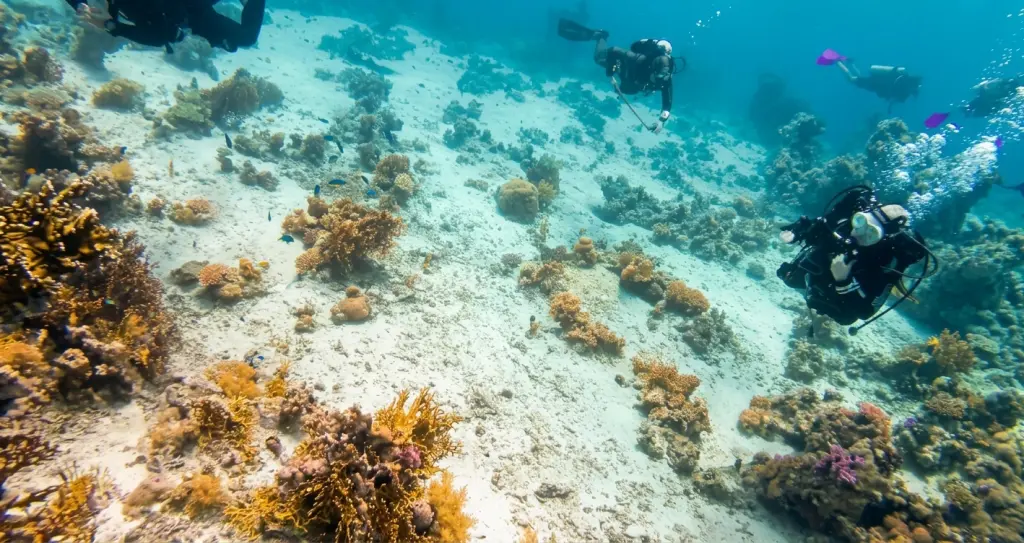
Understanding the drift is the key to Woodhouse Reef Egypt diving. This is not a dive you plan around a fixed line — it’s a journey along a moving wall.
Why There Are No Moorings
Because the reef is long, narrow, and exposed to the open strait, there is nowhere for a boat to sit safely against it. Dives are therefore drifts, run only when the sea allows. The standard approach is to enter at the southern half of the reef and let the current carry you north, with the guide managing depth, pace, and turn points. A surface marker buoy is essential so the boat can track and collect you at the end.
The Classic South-to-North Drift
The signature Woodhouse dive runs from south to north, ideally in the morning when sunlight falls directly on the reef and lights up the coral. It naturally divides into three acts.
The Southern Wall
You jump in at the southern tip, where a coral-clad wall drops to around 30 metres. Coral covers the reef all the way from the surface downward, and as the dive progresses the wall softens into a slope. Keep glancing down at the sand patches at the base — this is a prime spot to catch leopard (zebra) sharks or whitetip reef sharks resting on the bottom.
The Mid-Reef Canyon and Coral Garden
Roughly halfway along, at about 25–30 metres, a canyon runs parallel to the reef axis. On the northern half of the eastern side it opens out into a coral garden threaded with sandy alleys and, to one side, a luminescent red anemone that is a photographer’s dream. This is typically where the current begins to strengthen — and, if conditions on the western side are rough, where many dives are brought to a close after around 50 minutes.
The Northern Plateau and Saddle to Jackson
When the sea cooperates, the drift continues past the canyon to a sandy ledge that widens northwards into a coral plateau roughly 14–24 metres deep, set against the drop-off. This leads to the saddle connecting Woodhouse to Jackson Reef — the natural and scenic conclusion to the dive.
The Washing Machine: Tiran’s Most Notorious Currents
Beyond the northern tip of Woodhouse lies the Washing Machine, a stretch of water named for the whirling, multidirectional currents that spin off the reef’s edge where the flows from Woodhouse and Jackson collide. In the right conditions, experienced divers can extend the drift into it for a thrilling ride. In the wrong conditions, it is genuinely hazardous, capable of pushing divers away from the reef and towards the shipping lanes. The rule is simple: if the sea is choppy, end the dive and surface before the northern point. Never treat the Washing Machine casually.
- Only enter in good conditions and with a guide who knows the site.
- Deploy your SMB early so the boat can find you fast.
- Stay together — buddy separation in swirling current is the main risk.
- Be ready to abort and surface before the point if the water turns turbulent.
Marine Life at Woodhouse Reef
The same currents that make Woodhouse demanding also make it one of the richest reefs in Tiran for marine encounters.
Corals and Reef Structure
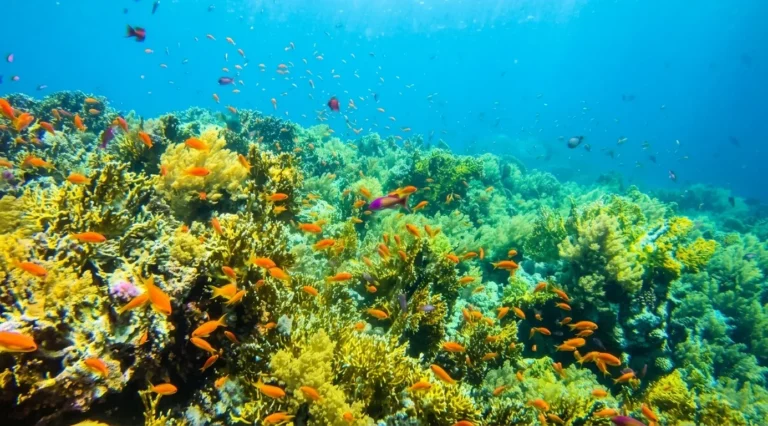
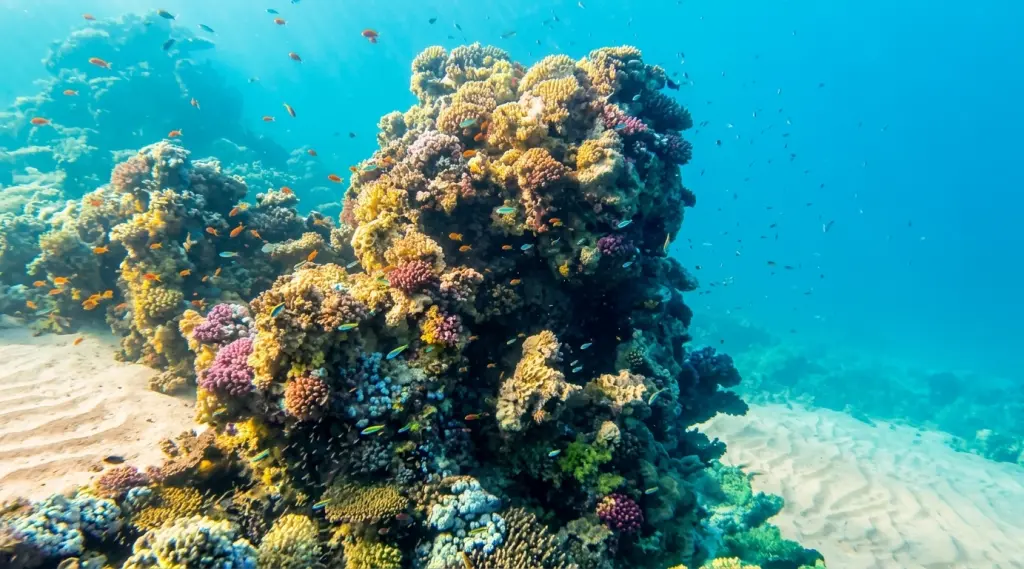
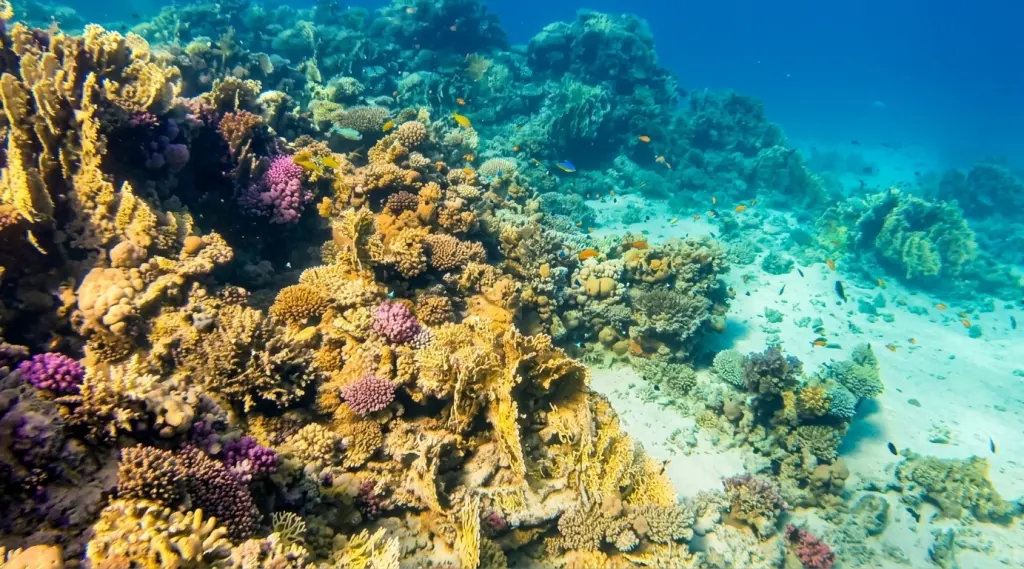
Coral coverage is superb, running from the surface down the wall. Expect vivid soft corals draping the drop-off, robust hard and branching corals, stands of fire coral, and colonies of black coral in the deeper zones around 22–26 metres. The coral garden around the canyon, with its sandy alleys, is a particular highlight.
Sharks of Woodhouse Reef
Woodhouse is regarded as one of the best shark-watching sites in the Straits of Tiran. Depending on season and luck, divers encounter:
- Grey reef sharks patrolling the wall and drop-off
- Whitetip reef sharks resting on the sand
- Leopard (zebra) sharks in the shallower sandy patches
- Scalloped hammerheads passing through in summer
- Occasional oceanic whitetip sharks in the blue
Turtles, Rays and Pelagics
Green and hawksbill turtles graze the coral, eagle rays glide along the drop-off, and schools of jackfish (trevallies) and giant tuna hunt in the current. The sandy ledges and plateau are reliable spots to slow down and scan for larger visitors moving in from the blue.
Macro Life for the Patient Diver
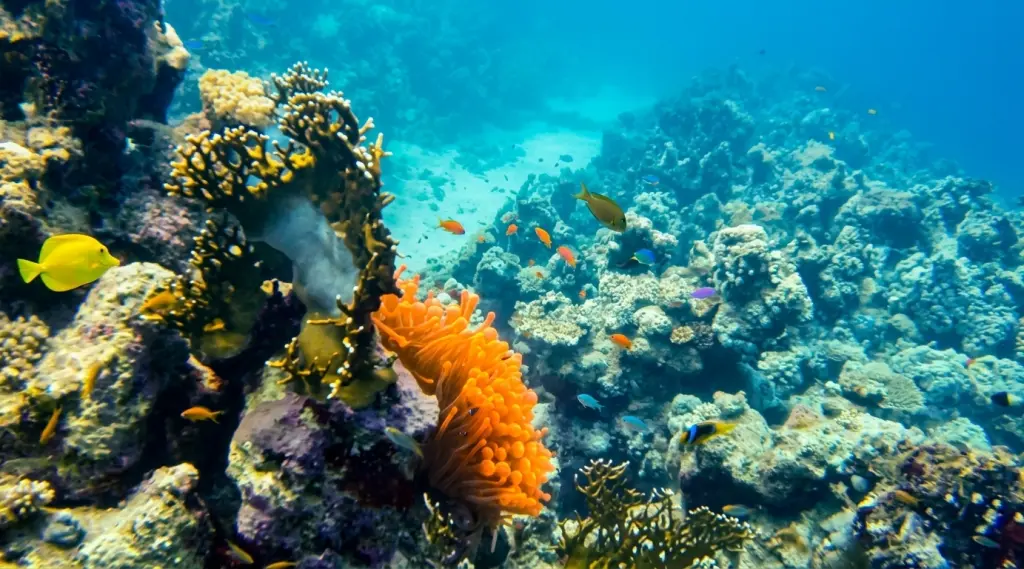
Woodhouse isn’t only about big animals. The coloured walls host clownfish tucked into anemones, and macro enthusiasts regularly find nudibranchs, butterflyfish, pufferfish, and moray eels among the corals. When the current is gentle enough to slow down, the reef rewards a close, patient eye.
Diving Conditions and Safety at Woodhouse Reef
Currents and Reading the Sea
Currents at Woodhouse range from mild at the start of a drift to strong and unpredictable near the northern point. Because the site is exposed and mooring-free, surface conditions matter as much as underwater ones — a choppy surface can make the pick-up difficult even after a calm dive. Trust your guide’s judgement on entry points and turnaround, and always dive with an SMB and reel.
Water Temperature and Visibility
Visibility is typically excellent, often exceeding 20–30 metres year-round. Water temperature swings seasonally, from around 21–23°C in the coolest winter months to roughly 27–29°C in high summer, so your exposure suit choice should match the time of year.
Depth and Dive Profile
Most Woodhouse dives run in the 12–30 metre range, with the wall dropping to about 30 metres in the south and the canyon sitting around 25–30 metres. The plateau near the saddle sits shallower at 14–24 metres, ideal for off-gassing towards the end of the dive. Recreational divers rarely need to go deep here — the action is well within standard limits.
Experience Level Required
Woodhouse is best suited to divers comfortable with drift diving. Because of the current and the open-water pick-ups, it leans intermediate to advanced.
- Newly certified divers should attempt it only in calm conditions with close supervision and prior drift experience.
- Advanced Open Water divers with good buoyancy and SMB skills will enjoy the full drift.
- Experienced drift divers can, in the right conditions, extend into the Washing Machine.
Best Time for Woodhouse Reef Egypt Diving
Tiran is among the most sheltered parts of the Northern Red Sea, so Woodhouse is divable across the year whenever the sea state allows the drift. That said, the experience shifts noticeably with the seasons.
Season-by-Season
| Season | Water Temp (approx.) | Highlights | Notes |
|---|---|---|---|
| Winter (Dec–Feb) | 21–23°C | Great visibility, quiet reefs | 5mm (or hooded) wetsuit; surface can be choppy, so drifts depend on wind |
| Spring (Mar–May) | 22–25°C | Balanced conditions, fewer crowds | Excellent shoulder season for drift diving |
| Summer (Jun–Sep) | 27–29°C | Hammerhead chances, warm calm water | Hottest and busiest; best sea state for the Washing Machine |
| Autumn (Oct–Nov) | 25–27°C | Warm water, great value, active reef | Another ideal window with lighter crowds |
Hammerhead Season
Scalloped hammerheads move through the Straits of Tiran in the summer months, with the strongest odds from roughly July to September. While Jackson’s north side is the classic hammerhead spot, Woodhouse’s exposed blue-water edges can also deliver sightings when conditions and timing align. Calm summer seas are also when the northern point and the Washing Machine are most reliably divable.
Planning Your Dive Trip from Sharm El Sheikh
Getting There
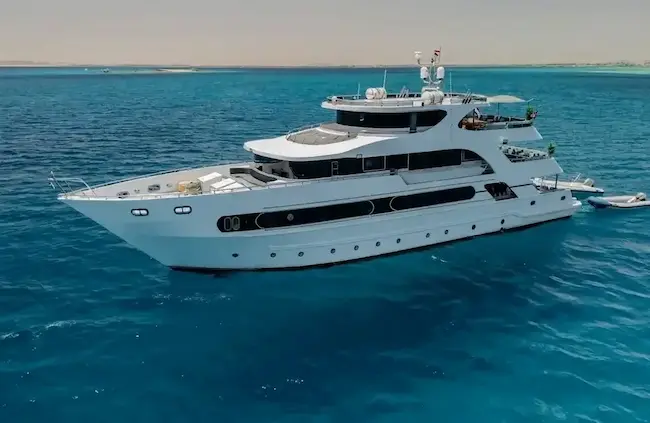
Woodhouse is reached by day boat from the marinas of Sharm El Sheikh, typically about an hour away. A standard Tiran day trip includes two or three dives, usually pairing Woodhouse with Jackson, Thomas, or Gordon. Because Woodhouse is exposed, operators often schedule it around the day’s best sea state rather than at a fixed time.
What to Bring
- Surface marker buoy and reel — non-negotiable for a mooring-free drift.
- Exposure suit — 3mm in summer, 5mm (hooded optional) in winter.
- Nitrox — helpful for longer bottom times; widely available in Sharm.
- Reef hook — some divers carry one, though good trim usually suffices.
- Torch — to reveal the true colour of the soft corals and canyon.
Marine Park Rules and Responsible Diving
The Straits of Tiran fall within a protected marine area, and Woodhouse’s health depends on careful diving. Maintain excellent buoyancy in the current, never touch or brace against coral (fire coral will punish contact), take only photographs, and follow your guide’s briefing precisely. Marine park fees generally apply and are arranged through your dive centre.
Woodhouse Reef vs. the Other Tiran Reefs
Seeing Woodhouse beside its neighbours makes its character clear.
| Reef | Position | How It’s Dived | Signature Feature |
|---|---|---|---|
| Jackson Reef | Northernmost | Moored, sheltered south side | Lara wreck and summer hammerheads |
| Woodhouse Reef | North-central | Drift only, no moorings | Longest reef, canyon and the Washing Machine |
| Thomas Reef | South-central | Drift, often deep | The Thomas arches and rich coral |
| Gordon Reef | Southernmost | Moored and easier | The Loullia wreck and garden eels |
Frequently Asked Questions
Is Woodhouse Reef suitable for beginner divers?
Only with caution. Because Woodhouse is a mooring-free drift with strengthening currents, it suits intermediate and advanced divers best. Newly certified divers should attempt it only in calm conditions, with prior drift experience and close guide supervision, and should avoid the northern point.
Why is Woodhouse Reef always dived as a drift?
The reef is long, narrow, and exposed, lying parallel to the strait’s current with no natural shelter and no fixed moorings. Boats cannot sit against it safely, so divers drift along the wall while the boat follows and collects them in open water at the end.
What is the Washing Machine at Woodhouse Reef?
It’s the turbulent stretch of water off the northern tip, where whirling currents from Woodhouse and Jackson collide. It can offer an exhilarating ride in good conditions but is dangerous in rough seas, so most dives are ended before the point unless the sea is calm.
What sharks can you see at Woodhouse Reef?
Grey reef and whitetip reef sharks are common, leopard (zebra) sharks rest on the sand, and scalloped hammerheads pass through in summer. Oceanic whitetips are occasionally seen in the blue, making Woodhouse one of Tiran’s better shark sites.
How deep is the dive at Woodhouse Reef?
Most of the dive sits between about 12 and 30 metres. The southern wall reaches around 30 metres, the canyon runs at roughly 25–30 metres, and the northern plateau shallows to 14–24 metres, keeping the dive comfortably within recreational limits.
When is the best time for Woodhouse Reef Egypt diving?
Spring and autumn offer the best balance of conditions and lighter crowds, while summer brings the warmest water, calmest seas for the northern point, and the chance of hammerheads. Winter diving is possible but depends on wind and surface conditions.
How do you get to Woodhouse Reef?
Woodhouse is accessed by day boat from Sharm El Sheikh, about an hour’s ride, usually as part of a Straits of Tiran trip combining two or three reefs. There is no shore access; it must be dived from a boat.
What should I pack for diving Woodhouse Reef?
Bring a surface marker buoy and reel for the drift, an exposure suit matched to the season, and consider Nitrox for longer bottom times. A torch helps bring out the colours of the soft coral and canyon.
Conclusion: Why Woodhouse Reef Belongs on Your Red Sea List
Woodhouse Reef Egypt diving distils everything that makes the Straits of Tiran world-class: a long, coral-blanketed wall, a dramatic canyon opening into sandy alleys, a genuine cast of sharks, turtles, and rays, and the pulse-quickening challenge of the Washing Machine. It’s a drift diver’s reef through and through — a site that asks for respect and good technique, then repays them with some of the most exhilarating diving in the Northern Red Sea.
Dive it in the right conditions, carry your SMB, stay within your training, and book with a Sharm El Sheikh operator who reads Tiran’s moods well. Do that, and Woodhouse won’t just be a line in your logbook — it will be the drift you replay in your mind long after the boat has carried you home.