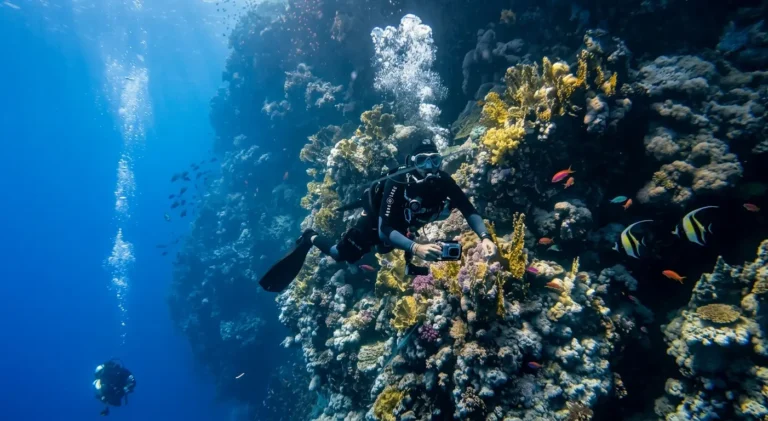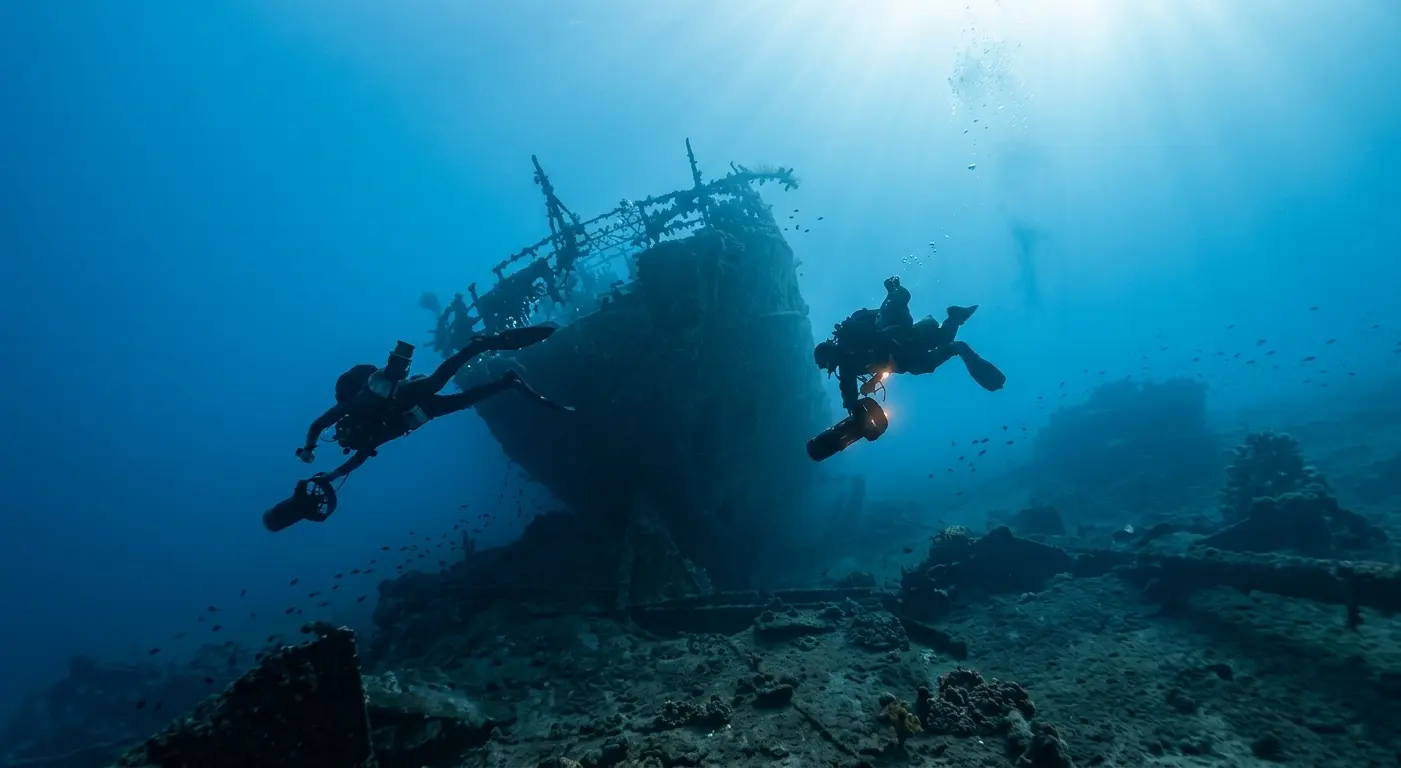
Almost everyone who dives Big Brother Island comes for the Numidia. They leave talking about the Aida Wreck. Sitting on the same island’s northern plateau, roughly a hundred metres from her famous neighbour, the Aida is the harder dive, the darker dive, and — for divers who like their wrecks with a story attached — by some distance the more interesting ship. A French-built lighthouse tender that survived a Luftwaffe bomber crashing into her own mast in 1941, only to be killed by weather sixteen years later while delivering men and supplies to the very lighthouse she existed to serve.
Here is the practical thing you need to know before anything else: the Aida is not a shallow warm-up dive. The recognisable ship begins at around 33 metres, where the hull tore in two. Above that there is little more than the old engine and scattered bow debris on the reef top at 7 metres. Below it, the wreck runs down a steep slope past the superstructure and quarterdeck to a rudder and propeller near 60–65 metres. This is a dive where you are at your maximum depth almost immediately, with a narrow window and often a current pushing you along a wall.
This guide gives you what the scattered dive-site pages do not: the verified construction history (and a blunt correction of the misinformation circulating about this ship), the full 1941 Heinkel He 111 story, a reconstruction of the 1957 sinking with the Norwegian tug that saved 77 men, a depth-by-depth map of the wreck as it lies today, the honest safety picture, the marine life, the Marine Park rules, and how the Aida Wreck compares to every other wreck you might dive on the same itinerary.
Aida Wreck: Quick Reference
| Attribute | Detail |
|---|---|
| Vessel name | SS Aida (frequently listed as Aida II) |
| Original role | Lighthouse and buoy tender / combined cargo-passenger vessel |
| Built | 1911, Ateliers et Chantiers de la Loire, Nantes, France (Yard No. 454) |
| Commissioned by | Egyptian Ports & Lighthouses Administration |
| Tonnage | 1,426–1,428 GRT (sources differ) |
| Dimensions | 75.1 m length × 9.7 m beam × ~7 m draught |
| Propulsion | Single triple-expansion steam engine, ~9 knots |
| War damage | October 1941 — attacked by a Heinkel He 111; the aircraft struck her mast and crashed. Beached, salvaged, repaired. |
| Date lost | 15 September 1957 |
| Cause | Struck the reef in heavy weather while approaching the Big Brother jetty |
| Casualties | None — all aboard rescued |
| Location | North/north-west plateau, Big Brother Island, Brothers Islands, Egyptian Red Sea |
| Approx. position | 26° 18.9′ N / 34° 50.5′ E (indicative — not for navigation) |
| Depth range | 7 m (bow debris/engine) · 25–33 m (break point) · 60–65 m (stern, propeller) |
| Requirement | Advanced Open Water minimum + ~50 logged dives; realistically Deep/Nitrox-trained. Propeller = technical only. |
| Access | Liveaboard only; inside a protected Marine Park (declared 1983) |
Where Is the Aida Wreck?
Big Brother Island
The Aida lies on the northern plateau of Big Brother Island, the larger of the two islets known collectively as the Brothers, or locally as El Akhawein. Big Brother is a sliver of rock roughly 200 metres long, topped by a stone lighthouse completed in 1883 and now run by the Egyptian Navy. The islands are the summits of submarine pinnacles rising from water more than 800 metres deep, roughly 60–67 km off the Egyptian coast east-north-east of El Quseir.
The Relationship to the Numidia
The two wrecks lie roughly 100 metres apart on the same end of the same island — the Numidia on the northern tip proper, the Aida a little around on the plateau’s western/north-western face. They are almost never dived as one profile. The Numidia hangs on a vertical wall; the Aida sits on a slope. The Numidia gives you a shallow section to burn off nitrogen; the Aida does not.
Why You Can Only Get There by Liveaboard
- No day boat operates to the Brothers — the distance makes it impossible.
- Marine Park access is permit-controlled and issued to licensed vessels.
- The islands are fully exposed; entries are made from tenders in open-ocean swell.
- The Navy determines how long boats may stay — sometimes one day, sometimes two.
The True History of the SS Aida: Setting the Record Straight
More nonsense circulates about this ship than about almost any other Red Sea wreck. Before the history, the corrections — because getting the facts right is the difference between a dive briefing and a rumour.
Common Myths About the Aida Wreck
| The claim you’ll read online | What the records actually show |
|---|---|
| “Built in Scotland in 1911” | Built in France — Ateliers et Chantiers de la Loire, Nantes, Yard No. 454, completed June 1911 |
| “Sold to the Italian navy in WWII” | No credible evidence. She was an Egyptian Ports & Lighthouses vessel, later used by the Egyptian navy |
| “Top speed 16 knots” | A single triple-expansion engine gave her roughly 9 knots |
| “Discovered by Jacques Cousteau in the 1960s” | Cousteau visited Big Brother, but the Aida sank against a reef in full view of a manned lighthouse in 1957. Nobody needed to “discover” her |
| “157 people died” | Zero fatalities. Everyone aboard was rescued |
| “Sunk by a German torpedo” | The 1941 attack was a near miss. The aircraft itself hit her mast and crashed. She was salvaged and served 16 more years |
1911: A Working Ship for a Working Coast
The Aida was commissioned by the Egyptian Ports & Lighthouses Administration and completed at Nantes in June 1911 — a combined cargo and passenger vessel designed for one unglamorous, essential job: keeping the Red Sea’s lighthouses supplied, crewed and maintained. At 75.1 m long and around 1,428 gross tons she was small, sturdy and slow. For three decades she did her rounds without incident and without headlines.
Technical Specifications
- Length: 75.1 m · Beam: 9.7 m · Draught: approximately 7 m
- Tonnage: 1,426–1,428 GRT (sources disagree on the final digit)
- Machinery: single triple-expansion steam engine, single screw
- Service speed: roughly 9 knots
- Role: lighthouse and buoy tender; later troop and supply transport
October 1941: The Night a Heinkel Hit Her Mast
In early October 1941, German aircraft attacked shipping in the Gulf of Suez. The most famous casualty of that period is the Rosalie Moller, sunk at Anchorage H. The official British war diary entry recording that loss also records the Aida — a Ports and Lights vessel — going down at Zafarana anchorage after a Heinkel He 111 struck her mast and crashed. Crucially, the same entry noted she could be salvaged.
Why She Survived
The difference between the Aida and the Rosalie Moller was motion. The Rosalie Moller lay at anchor — a stationary target. The Aida was under way at full speed. Her captain altered course at the last possible moment; the bomber missed, clipped the mast, and went into the sea. The ship was badly damaged, and the captain’s quick thinking in beaching her is what stopped her sinking outright. She was refloated, repaired, and put back to work. After the war she passed to Egyptian naval service.
15 September 1957: Killed by the Lighthouse She Served
The Aida was tasked with delivering personnel and supplies to the Egyptian Coast Guard station and lighthouse crew on Big Brother Island — accounts put around 157 military personnel aboard. The drop-off was the jetty on the island’s south-eastern side. The Red Sea was in a foul mood that day: fierce storms, heavy swell, and a jetty that offers no shelter worth the name.
Timeline of the Sinking
- Approach. In heavy seas, the ship is slammed against the rocks near the jetty and breaches her hull.
- Flooding. Water pours in and the stern begins to settle. The captain gives the order to abandon ship.
- Rescue. A distress signal brings assistance — the Norwegian tug Bergehus takes 77 people aboard; the remainder are landed on the island. Nobody dies.
- Drift. The stricken Aida drifts north-west along the reef. Attempts to save her fail.
- Grounding. Her bow catches on the northern plateau, holding her briefly in place.
- Break-up. With the stern’s weight unsupported, the hull tears in two forward of the central superstructure. The stern slides down the slope. The bow stays on the reef top, where wind and waves grind it to fragments over the following decades.
The “Aida II” Question
You will see this wreck listed as both “Aida” and “Aida II.” The Ports & Lighthouses Administration reused the name across successive vessels, and dive operators adopted the ordinal to distinguish this ship from her predecessor. Both labels point to the same 1911 French-built tender on the same plateau. Don’t let a booking page’s naming convention convince you there are two wrecks.
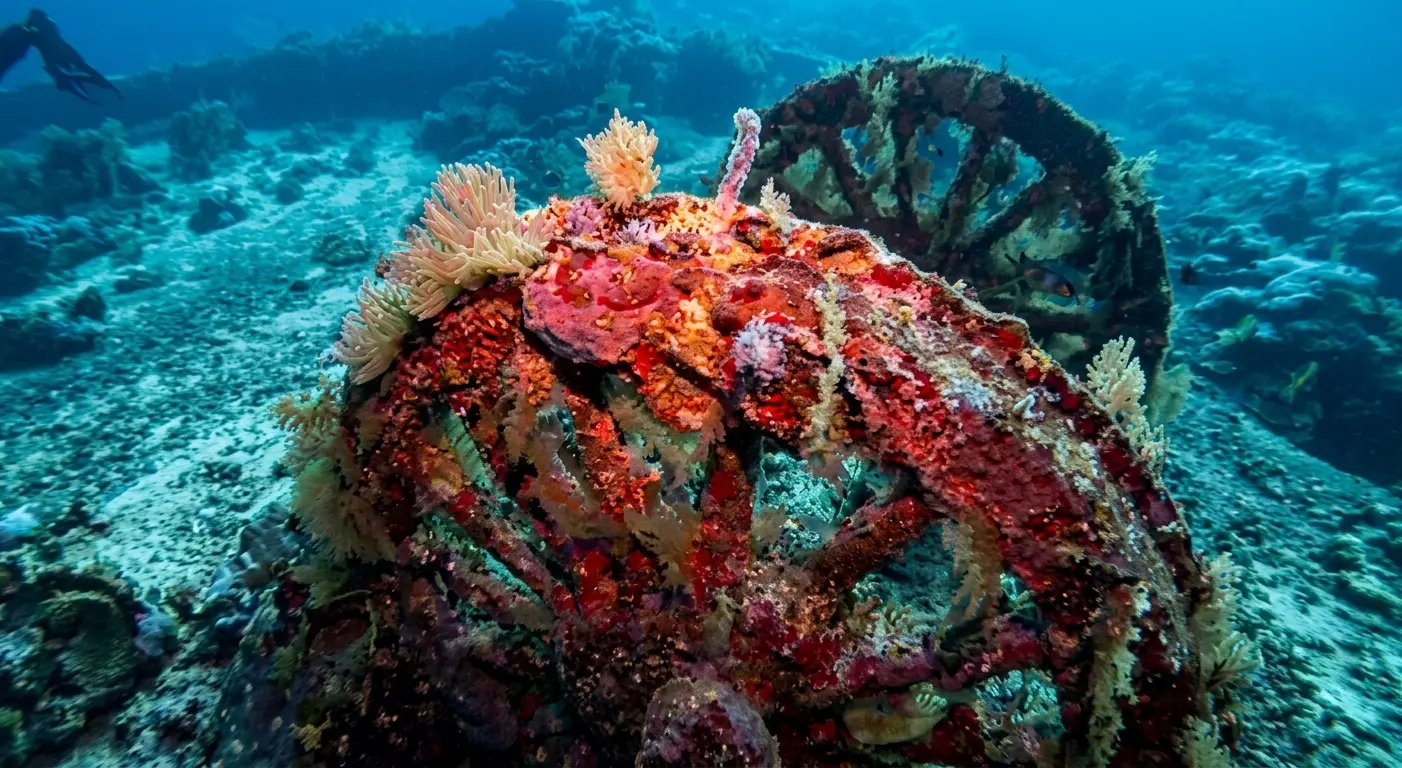
Diving the Aida Wreck: The Site as It Lies Today
Orientation and Layout
The Aida is a slope wreck. Her surviving section rests keel-down on a ledge on the western face of the northern plateau, running from the tear at roughly 33 metres down to the stern in the 60–65 metre range. Some sources describe the intact remains as running from about 25 m to 60 m — a fair reflection of how the break zone and upper structure sit. Either way, the operative fact is the same: the real wreck starts deep and only goes deeper.
Depth-by-Depth Map
| Depth | What’s there | Access level |
|---|---|---|
| 7 m | The old engine and last fragments of the bow, ground into the reef top | Any certified diver (usually seen only in passing) |
| ~25–33 m | The break — a torn cross-section of the hull, the wreck’s visual signature | Advanced / Deep-trained |
| 33–40 m | Central superstructure (badly damaged); the port-side gangway is the best-preserved element | Advanced / Deep-trained; 40 m legal limit |
| 40–50 m | Quarterdeck with rotted planking exposing open steelwork; heavy winches ahead of the cargo hatches; davits along the railings | Decompression / technical |
| ~50–55 m | Engine room — swim-through possible for trained divers, exiting via the break | Technical, guide-approved |
| ~55–60 m | Remains of the helm; stern structure | Technical |
| ~60–65 m | Rudder and propeller — the wreck’s deepest point | Technical / mixed gas only |
The Signature Features
The Break
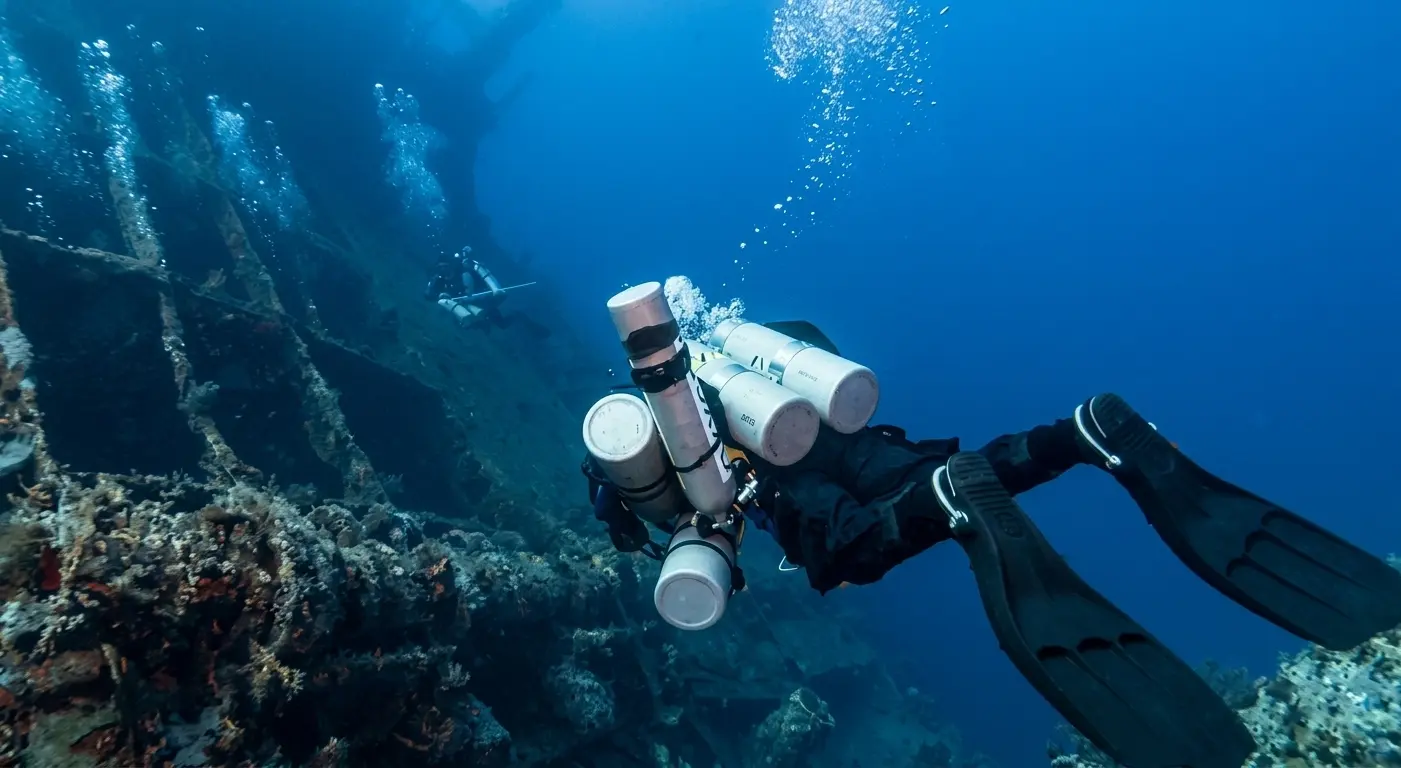
The torn hull edge is the shot every photographer wants — a ragged steel wound with blue behind it, framing the slope. It is also your navigational anchor: everything on this dive is described as above or below the break.
The Port Gangway
The central superstructure took the worst of six decades of storms, but the port-side gangway survived in reasonable shape. It gives the Aida Wreck a rare sense of a ship you could still walk through.
The Quarterdeck and Engine Room
With the wooden decking long gone, the quarterdeck reads as an open steel skeleton — light pours through, and for suitably trained divers the engine room offers a genuine swim-through with an exit at the break. The mainmast broke off long ago; the davits still hang along the rails.
The Propeller
Sitting at the wreck’s lowest point around 60–65 m, the propeller is the trophy nobody on a recreational profile gets to keep. It requires decompression planning, appropriate gas, and a team.
Coral and Condition
The entire wreck is heavily encrusted. Because the Brothers escaped the diver pressure that damaged parts of the northern Red Sea, coral cover here is exceptional — but at 35–50 metres, colour is gone before you notice it’s missing. A torch is not optional on the Aida; it is the entire visual experience. Without one you are diving a grey wreck.
Aida Wreck Diving: Requirements, Currents and Dive Planning
Who Should Dive It
- Certification: Advanced Open Water or equivalent (CMAS 2-star, SSI AA, BSAC Sports Diver) is the floor, not the target.
- Logged dives: Operators typically require at least 50 for the Brothers and check logbooks at boarding.
- Strongly recommended: Deep Diver specialty and Nitrox — at these depths both change the dive materially.
- Skills: drift diving, wall/slope diving, precise buoyancy, DSMB deployment, comfort with short bottom times.
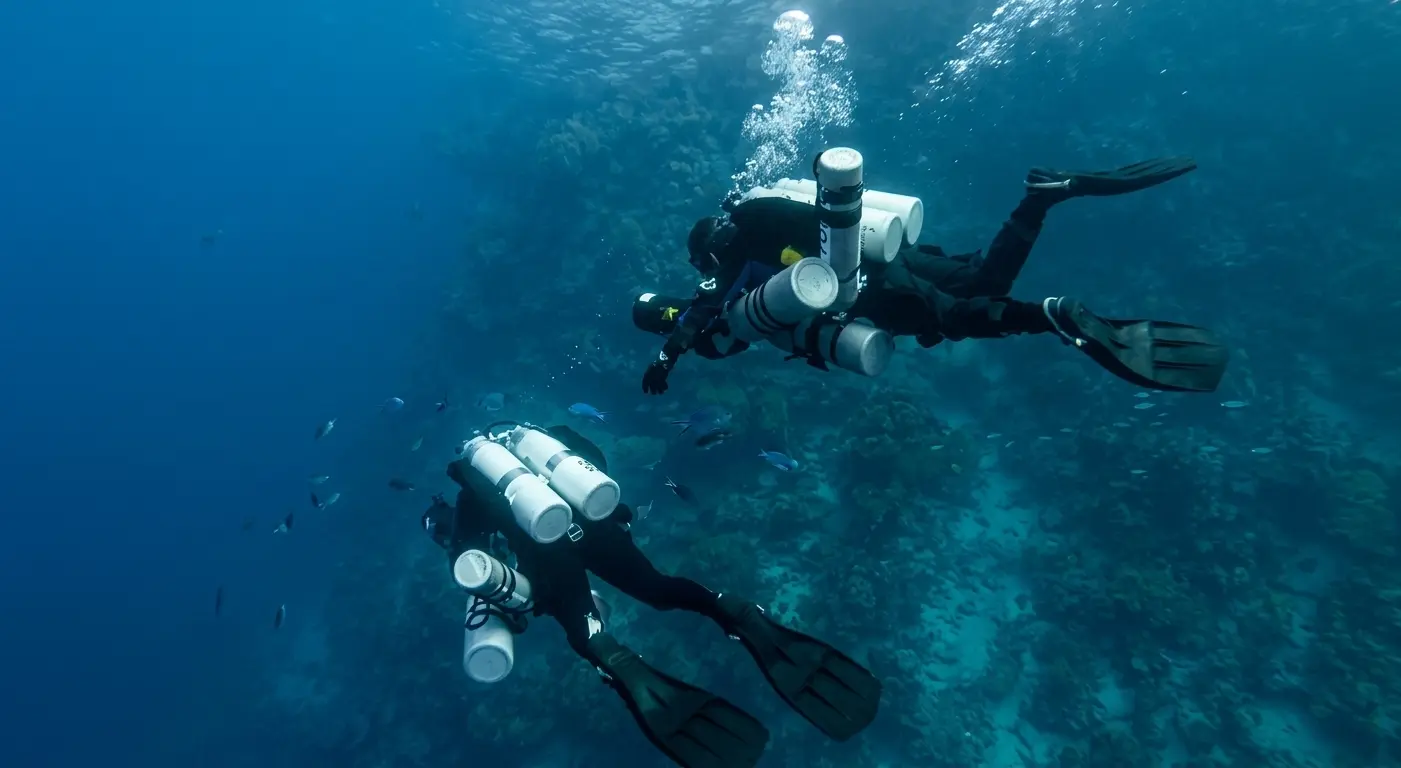
- Legal limit: 40 m recreational maximum in Egyptian waters. Below that you are technical diving, with the equipment, training and team that implies.
Currents and Conditions
Current at the Brothers generally runs north to south and hits the island’s northern end first — exactly where the Aida sits. It can be benign or it can be a conveyor belt, and it can change between briefing and splash. Down-currents on the slope are the genuine hazard, and the reason night diving is prohibited across the Marine Park. Visibility typically averages around 20 m and is often much better.
A Realistic Recreational Dive Plan
- Negative entry from the tender. Get down and off the surface fast.
- Descend the slope directly to the break at around 33 m — this is your deepest point and it arrives within two minutes.
- Work along the superstructure and gangway, torch on, watching your computer more often than feels necessary.
- Ascend the slope steadily. Do not linger deep for one more frame — the Aida has no shallow section to bail you out.
- Finish over the reef top near the old engine at 7 m, then complete a generous safety stop in the coral.
Non-Negotiable Safety Points
- The absence of a shallow wreck section means your entire nitrogen load is front-loaded. Plan conservatively.
- Carry your own DSMB and reel. Treat it as mandatory equipment, not a nice-to-have.
- Gloves and knives are prohibited in the Marine Park.
- Penetration of the engine room is a training-and-guide decision, never an impulse at 50 m.
- The nearest chamber is a very long way away. This is the single most important sentence in this guide.
Marine Life Around the Aida Wreck
A 75-metre steel hull on a pristine plateau does what steel always does in tropical water: it becomes a reef.
On and Around the Structure
- Dense soft coral, sponges and gorgonians across virtually every surface
- Schooling snapper and fusiliers over the quarterdeck
- Groupers holding station in the structure; moray eels in the steel voids
- Anthias clouds, lionfish, glassfish shoals in the sheltered pockets
- Napoleon wrasse and giant trevally patrolling the plateau edge
In the Blue
- Grey reef sharks — near-resident at Big Brother
- Oceanic whitetips — best odds in the cooler months, roughly late October to April
- Scalloped hammerheads — schooling in winter and spring
- Threshers — more a Little Brother speciality, but possible
- Mantas and hawksbill turtles — occasional and always memorable
The catch: at 35–50 m your gas is disappearing and your no-stop time is measured in single digits. Divers who spend the Aida staring into the blue for sharks tend to come back with neither the sharks nor the wreck. Dive the ship; let the blue happen.
When to Dive the Aida Wreck
| Period | Water temp | Sea state | Notes |
|---|---|---|---|
| March–May | 23–26 °C | Improving, breezy | Brothers season ramps up; hammerhead and thresher activity |
| June–August | 27–30 °C | Calmest, best visibility | Warmest water and longest days — the most comfortable Aida diving |
| September–November | 26–28 °C | Excellent | Arguably the ideal balance of conditions, visibility and pelagics |
| December–February | 21–24 °C | Roughest; cancellations common | Peak shark season, but a real chance the Brothers days are lost to weather |
There is a grim symmetry worth remembering: the Aida was killed by exactly the sort of weather that will cancel your dive on her. Every honest operator builds alternates into a Brothers itinerary. Book with that expectation.
Photographing the Aida Wreck
- Torch and strobes are essential. At 40 m the coral is monochrome without light.
- Shoot wide, shoot fast. Bottom time is the constraint, not composition.
- Frame the break. The torn hull with blue behind it is the image that defines this wreck.
- Use a model. Nothing else conveys the scale of the slope.
- Pre-set the camera on the boat. Fiddling with settings at depth is how divers get narced and deep simultaneously.
Aida Wreck vs Other Red Sea Wrecks
| Wreck | Depth | Level | Character |
|---|---|---|---|
| Aida Wreck | 7 m / 33–65 m | Advanced to technical | Deep slope wreck, coral-clad, engine-room swim-through, war survivor |
| Numidia | 8–80 m+ | Advanced to technical | Vertical wall wreck, train wheels, mast at 90°, same island |
| Rosalie Moller | 17–50 m | Advanced | The Aida’s 1941 sister-in-misfortune; intact and atmospheric |
| SS Thistlegorm | 16–32 m | Advanced | WWII cargo — trucks, motorcycles, locomotives |
| Giannis D | 5–27 m | Open Water+ | Easy, disorienting, photogenic at Abu Nuhas |
| Salem Express | 10–30 m | Advanced | A memorial site, dived with restraint |
Diving the Rosalie Moller and the Aida on the same trip is one of the most quietly powerful pairings in Red Sea wreck diving: two ships attacked in the same week of October 1941, one sunk where she lay, the other saved by a captain who refused to sit still — and then lost anyway, sixteen years later, to a storm.
Conservation, Rules and the Wreck’s Future
- The Brothers have been protected since Egypt’s 1983 marine reserve declarations; access requires permits held by licensed vessels.
- Night diving is prohibited throughout the Marine Park.
- No gloves, no knives, no touching, no souvenirs. The Aida is protected heritage as well as habitat.
- Vessel numbers and mooring duration are controlled by the authorities and can change without notice.
- The Aida is genuinely deteriorating. Storms have already destroyed the bow entirely; the superstructure is badly degraded. Academic photogrammetry projects now document vulnerable Egyptian wrecks precisely because sites like this one are on a clock.
- Buoyancy is conservation. One careless fin kick at 40 m undoes decades of coral growth.
Planning a Trip to the Aida Wreck
Getting There
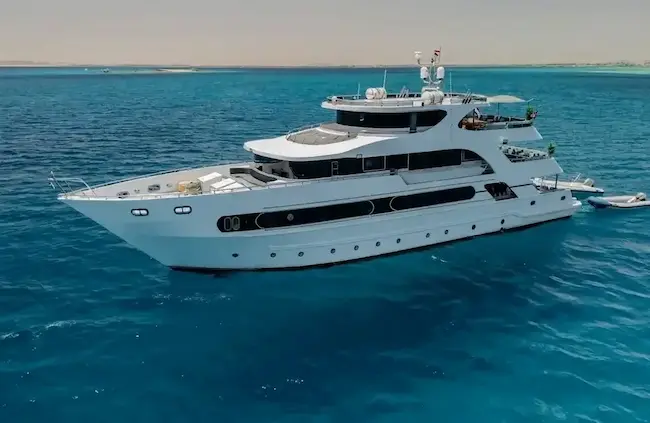
Fly into Marsa Alam (RMF) or Hurghada (HRG). Brothers liveaboards typically depart Port Ghalib or Hurghada on 7-night itineraries — commonly “Brothers, Daedalus and Elphinstone” (BDE) or “Simply the Best.” The Aida and Numidia are both dived on the Big Brother day, usually as separate profiles.
What to Bring
- Personal DSMB and reel
- A dive computer, ideally with a backup
- A good primary torch — the single highest-impact item for this wreck
- Nitrox certification card (get it before you come if you don’t have it)
- 3 mm summer / 5 mm winter wetsuit; hood in the cooler months
- Certification cards and a real logbook — crews do verify
Managing Expectations
You may get one dive on the Aida. You may get none if the Navy restricts mooring or the sea has other plans. Treat every Aida dive as a gift rather than an entitlement and you’ll dive it better and safer.
Frequently Asked Questions
How deep is the Aida Wreck?
Scattered bow remains and the old engine sit at around 7 metres on the reef top, but the recognisable ship begins at the break at roughly 25–33 metres and descends to the stern, rudder and propeller near 60–65 metres. Recreational divers work the 33–40 metre band; anything deeper requires technical training and decompression planning.
Can beginners dive the Aida Wreck?
No. The wreck effectively starts at 33 metres, currents can be strong, and there is no shallow section to extend the dive safely. Most operators require Advanced Open Water plus around 50 logged dives for the Brothers, and Deep and Nitrox training are strongly advisable on top of that.
Where was the Aida actually built?
In France — at the Ateliers et Chantiers de la Loire yard in Nantes, completed in June 1911 for the Egyptian Ports & Lighthouses Administration. Several popular dive-site pages claim Scotland, which is incorrect. She was a French-built lighthouse and buoy tender, roughly 75 metres long and around 1,428 gross tons.
Did anyone die when the Aida sank?
No. On 15 September 1957 the ship struck the reef in heavy weather while approaching the Big Brother jetty with military personnel and supplies aboard. The Norwegian tug Bergehus took 77 people off, the rest were landed on the island, and the accident claimed no lives.
What happened to the Aida in World War II?
During the October 1941 German air attacks on Red Sea shipping — the same raids that sank the Rosalie Moller — a Heinkel He 111 attacked the Aida. She was under way rather than at anchor, and a last-second course change caused the bomber to miss, clip her mast, and crash. Badly damaged, she was beached by her captain, then refloated, repaired and returned to service for another sixteen years.
Is the Aida the same wreck as the “Aida II”?
Yes. The name was reused across successive Egyptian Ports & Lighthouses vessels, and operators added the ordinal to distinguish this ship from her predecessor. Whether a booking page says “Aida” or “Aida II,” it means the 1911 French-built tender on Big Brother Island’s northern plateau.
Can you penetrate the Aida Wreck?
Suitably trained divers can swim through the engine room and exit via the break, and the missing wooden decking means light and openings are plentiful. But this is penetration at 40–55 metres in a badly degraded 115-year-old hull — a decision for wreck-trained, appropriately equipped divers with explicit guide approval, never a spontaneous one.
Which is the better dive — the Aida or the Numidia?
The Numidia is more spectacular and far more accessible, with a coral-covered wall running from 8 to 80 metres and a shallow section that forgives you. The Aida is deeper, darker and more demanding, but rewards divers who want structure, swim-throughs and a far richer story. Most itineraries let you dive both — do exactly that.
Do you need Nitrox for the Aida Wreck?
It isn’t legally required, but on a wreck whose shallowest real structure is at 33 metres, enriched air meaningfully extends no-decompression limits and reduces fatigue across four or five dives a day. If you are booking a Brothers liveaboard, getting Nitrox certified beforehand is the best-value preparation you can make.
Final Thoughts: Why the Aida Wreck Deserves More Than a Footnote
The Aida Wreck will never win the popularity contest on Big Brother Island. She is deeper than the Numidia, less photogenic, shorter on bottom time and harder to shoot. She is also the more human ship: a vessel whose entire purpose was to keep lighthouses burning for other sailors, who dodged a Heinkel by refusing to hold course, who was patched up and sent back to work, and who finally died on a stormy September afternoon doing precisely the job she was built for — and took nobody with her.
Dive her properly. Get the depth training, get the Nitrox, carry a torch that actually works, plan the profile before you splash, and give the break the time it deserves rather than chasing sharks into the blue. The Aida Wreck asks more of divers than almost anything else at the Brothers, and it gives back exactly in proportion to what you bring.