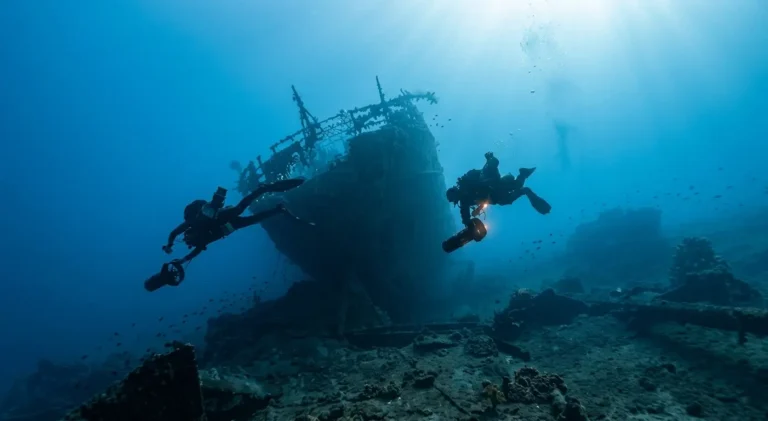
Drop into the water off the northern tip of Big Brother Island and you will understand, within thirty seconds, why the Numidia Wreck is routinely voted one of the finest shipwrecks on the planet. A 137-metre British steamer lies pinned to a vertical coral wall at a gravity-defying angle, her bow fused into the reef in eight metres of water and her stern resting on a narrow ledge at eighty metres, with nothing but 800 metres of open blue beneath her. She is not a wreck you swim around. She is a wreck you fall down.
Most divers arrive knowing only the postcard version: coral-caked train wheels, a mast standing proud at ninety degrees to a hull that isn’t level, and hammerheads cruising the edge of visibility. What they rarely arrive with is a plan — and the Numidia punishes divers without one. The current here runs hard from north to south, the depth gradient is merciless, and a wreck that starts at eight metres and finishes at eighty makes it dangerously easy to drift deeper than you intended while chasing one more photograph.
This guide covers everything: the true story of the July 1901 grounding and the Board of Trade inquiry that ended one man’s career, a metre-by-metre map of what you will see at each depth, the certification and current realities, the marine life calendar, the Marine Park rules, and how to actually get there. Whether you are booking your first Brothers Islands liveaboard or planning a trimix descent to the propeller, this is the reference you want before the briefing.
Numidia Wreck at a Glance
Before the detail, here is the quick-reference summary experienced divers scan first.
| Attribute | Detail |
|---|---|
| Vessel name | SS Numidia (British general cargo steamship) |
| Built | Launched 4 February 1901, D. & W. Henderson & Co., Meadowside yard, Glasgow |
| Owner | Anchor Line Ltd. |
| Dimensions | ~137 m length × 16.7 m beam; 6,399 gross tons |
| Date lost | Approx. 02:00, 20 July 1901 |
| Cause | Navigational error — grounding on the northern reef of Big Brother Island |
| Location | North tip of Big Brother Island, Brothers Islands (El Akhawein), Egyptian Red Sea |
| Approx. coordinates | 26° 19′ N / 34° 50′ E (indicative only — never use for navigation) |
| Depth range | 8 m (bow debris) to 80 m+ (stern, rudder, propeller) |
| Orientation | Steeply inclined, bow shallow, stern deep, listing to port on the reef wall |
| Minimum requirement | Advanced Open Water (or equivalent) + typically 50 logged dives; deep sections require technical training |
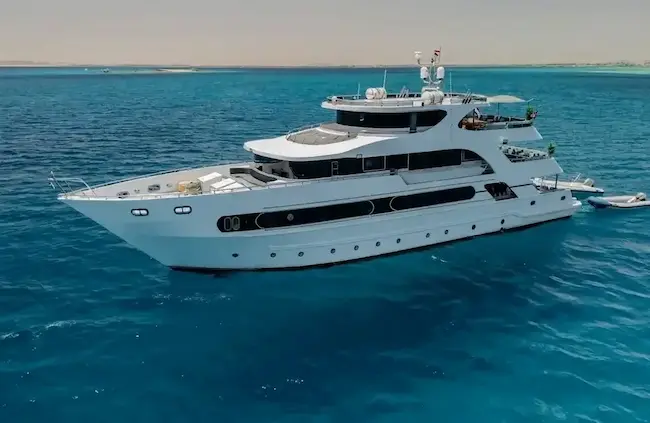
| Access | Liveaboard only — no day boats reach the Brothers |
| Protection status | Inside a declared Egyptian Marine Park (1983); night diving prohibited |
Where Is the Numidia Wreck Located?
Big Brother Island: A Speck in the Middle of the Red Sea
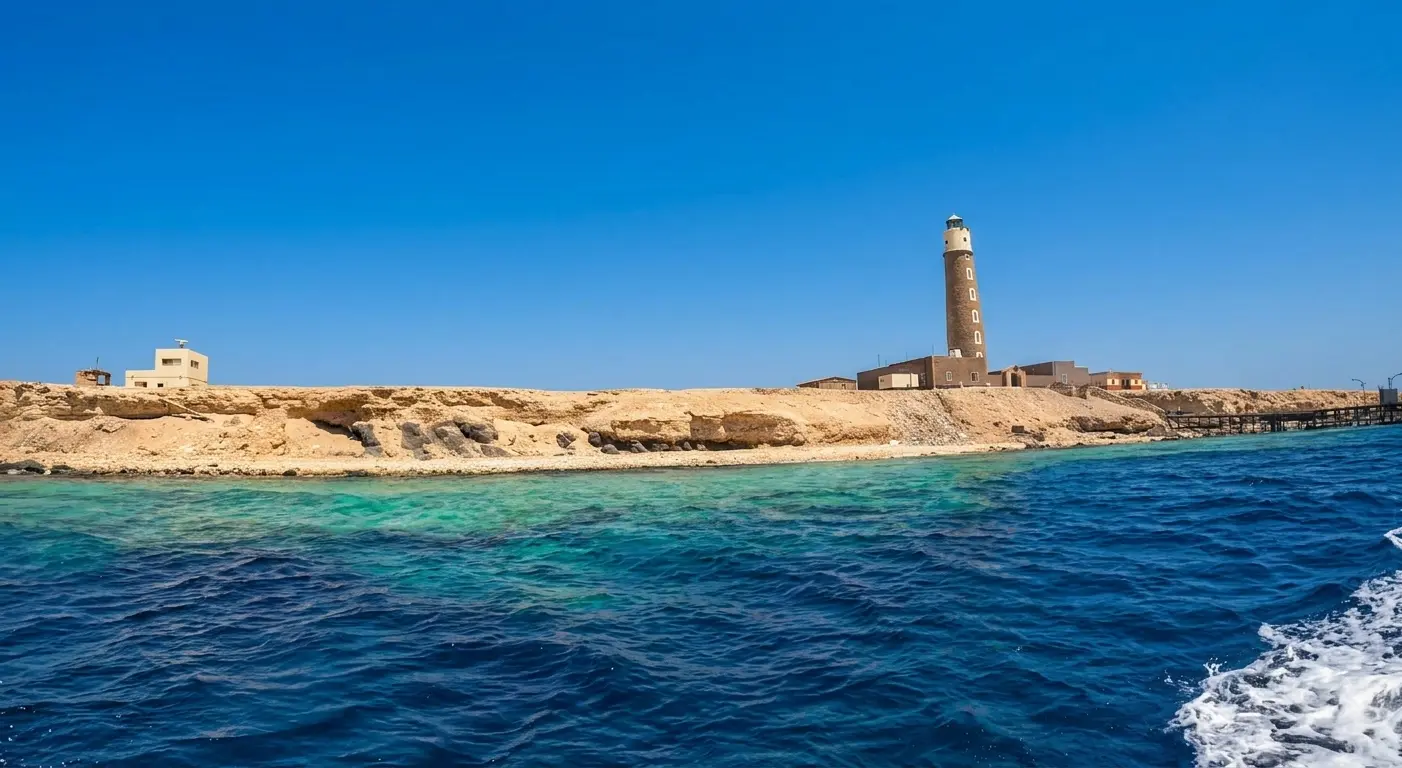
The Numidia lies on the northern reef of Big Brother Island, the larger of two barren rocky islets known collectively as the Brothers, or locally as El Akhawein. Big Brother is astonishingly small — roughly 200 metres long and about 20 metres wide, a sliver of rock crowned by a stone lighthouse. Little Brother sits about a kilometre to the south. Both islands are the exposed summits of submarine pinnacles rising from a seabed more than 800 metres down, which is precisely why they produce such extraordinary diving and such punishing conditions.
Distance from the Egyptian Coast
The Brothers sit roughly 60–67 km offshore, east-north-east of El Quseir, placing them a meaningful distance out into the open Red Sea. There is no land-based access. Nothing shelters the islands from wind, so surface conditions are frequently rough even when the forecast looks benign from Port Ghalib or Hurghada.
Why the Numidia Wreck Is Liveaboard-Only
- Distance: No day boat can safely make the round trip and deliver useful bottom time.
- Sea state: Entries and exits are made from tenders or the mother ship in open ocean swell.
- Permits: Marine Park access is controlled and issued to licensed vessels.
- Weather windows: Boats sometimes cannot approach or dive the island at all — a genuine risk on any Brothers itinerary.
The History of the SS Numidia: How a New Ship Died in Six Months
Built in Glasgow at the End of the Victorian Age
The Numidia was launched on 4 February 1901 by D. & W. Henderson & Co. at their Meadowside yard in Glasgow, less than a fortnight after the death of Queen Victoria. Henderson — founded in 1869, the year the Suez Canal opened — had built a reputation on iron-hulled ocean-going vessels and efficient compound steam machinery. The Numidia carried a triple-expansion steam engine yet retained two masts, a common hedge of the era that let crews take advantage of wind and conserve coal.
Technical Specifications
- Length: approximately 137 metres (449 feet)
- Beam: approximately 16.7 metres (55 feet)
- Tonnage: 6,399 gross tons
- Propulsion: triple-expansion steam engine, single screw
- Rig: two masts (the surviving mizzen is the wreck’s signature feature)
- Operator: Anchor Line Ltd., Glasgow
The Maiden Voyage and the Fatal Second Run
Her first voyage — Britain to Bombay and Calcutta via the Suez Canal — passed without incident. On 6 July 1901 she sailed again from Liverpool under Captain John Craig, an experienced master in his mid-fifties, bound once more for Calcutta with a general cargo that included rails and rolling stock wheels destined for the Indian railways. Those wheels are the reason thousands of divers now make the pilgrimage.
The Night of 19–20 July 1901
The Numidia cleared Suez on 19 July and ran south into the open Red Sea. Around 01:00 on the 20th, Captain Craig sighted the Big Brother light, set a course intended to pass roughly a mile west of the island, handed the watch to Second Mate James Tulloch with instructions to be called when the light was abeam, and went below to sleep.
Timeline of the Grounding
- ~01:00 — Big Brother lighthouse sighted; course set; Captain Craig retires.
- ~01:30 — Tulloch alters course. The change is insufficient to clear the island, and the master is not informed.
- Shortly after — The officer of the watch, in all likelihood, falls asleep.
- ~02:00 — The Numidia strikes the reef at the island’s northern shore, within a few hundred feet of the lighthouse itself.
- ~04:00 — Despite full astern, the bow is fast, the number one hold is breached and flooding faster than the pumps can cope.
Seven Weeks of Salvage
Refloating attempts failed. Other vessels came alongside, crew were landed on the island, and Captain Craig remained on Big Brother for roughly seven weeks directing the recovery of the cargo onto other ships. Most of it was saved. The train wheels lashed to the deck — heavy, awkward, and evidently not worth the effort — were left where they lay. They are still there, now barely recognisable under a century of coral.
Breaking in Two
With the cargo gone and the hull working relentlessly against the reef, tides and storms did the rest. The Numidia broke roughly amidships, forward of the central superstructure. The bow stayed jammed on the reef top, where wind and wave gradually reduced it to scrap now indistinguishable from the coral. The stern section slid backwards down the wall and — remarkably — stopped, coming to rest on a small shelf around 80 metres down instead of vanishing into the abyss. That single stroke of luck is the only reason there is a Numidia Wreck to dive at all.
The Board of Trade Inquiry
An official inquiry convened in Glasgow in October 1901. It criticised Captain Craig for failing to make an adequate course alteration and for leaving the bridge before the ship had safely passed the island. But responsibility fell principally on Second Mate James Tulloch, who had altered course without informing the master and had almost certainly fallen asleep on watch. Tulloch’s certificate was suspended for nine months. Two careers bruised, one 6,399-ton ship lost, and — by the standards of 1901 shipwrecks — not a single fatality reported.
Anatomy of the Numidia Wreck: What You See at Every Depth
The genius of this dive site is its vertical layering. The Numidia Wreck is not one dive; it is four or five dives stacked on top of each other, and your certification decides which floors you get to visit.
Depth Profile Map
| Depth | What you’ll find | Who can reach it |
|---|---|---|
| 5–8 m | Scattered bow debris, first pair of train wheels, dense hard coral | All certified divers |
| 12 m | Second pair of train wheels; reef wall alive with anthias | All certified divers |
| 18–22 m | Bridge remains, cabins, funnel area, two lifeboat davits still swung out | Advanced Open Water |
| 30–40 m | Main deck, engine-room vents, engine room with triple-expansion machinery below | Deep-trained; 40 m legal limit |
| 46 m | Entrance to number 3 hold, first of the aft holds | Technical / decompression |
| 50 m | Base of the mizzen mast, large deck winches (booms long gone) | Technical / decompression |
| 80 m | Rounded stern, rudder, propeller — the wreck’s holy grail | Trimix, full technical team |
The Train Wheels
The signature image of the Numidia Wreck. Two pairs of cast-iron railway wheels intended for the Indian Imperial Railways sit at roughly 8 m and 12 m, so heavily overgrown that first-time divers frequently swim past without recognising them. Ask your guide to point them out on the descent, not the ascent — you will have air and attention to spare.
The Superstructure and Davits
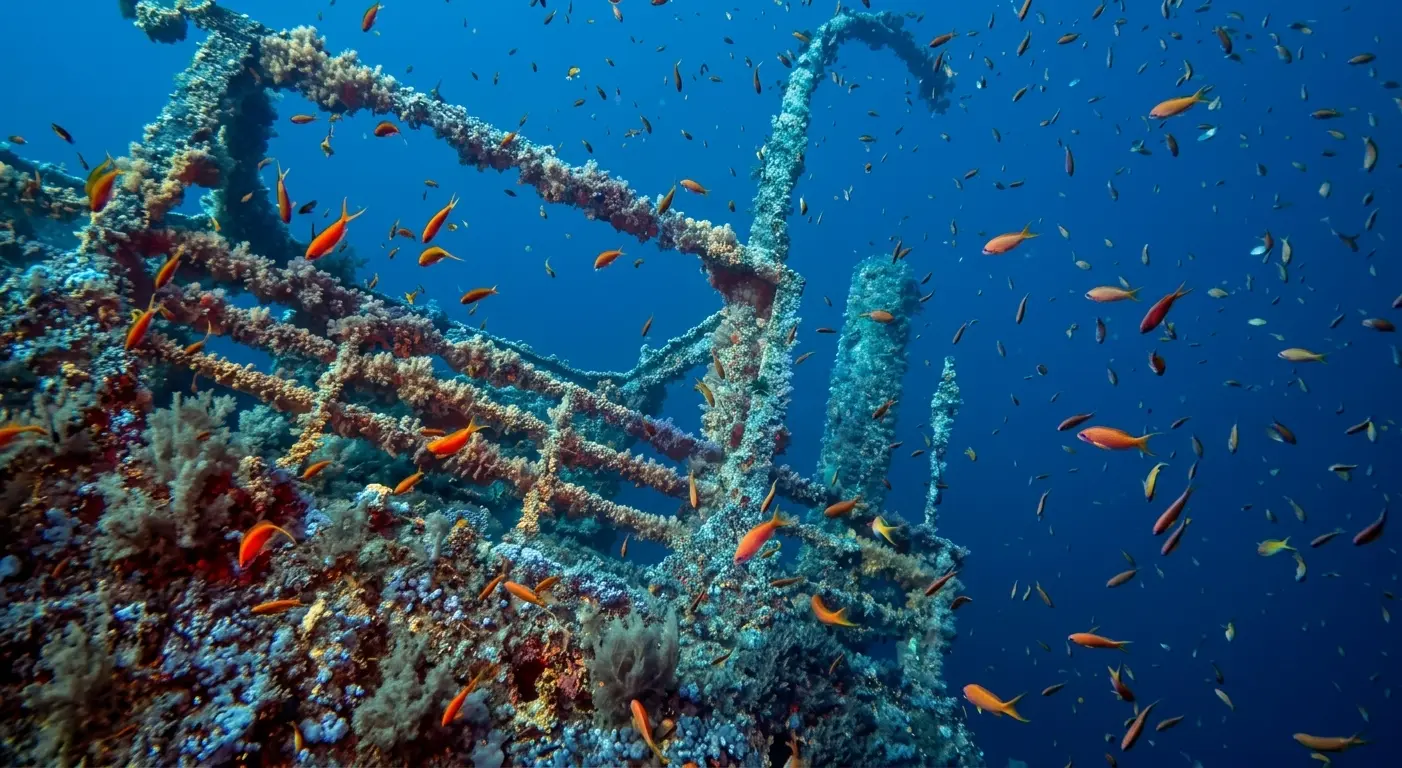
Around 20 m the bridge, cabin block and funnel area emerge from the coral. The wooden decking rotted away decades ago, leaving an open steel skeleton that light pours through — the reason underwater photographers rate this wreck so highly. The lifeboat davits on both sides remain swung outboard, frozen in the position of an evacuation that happened 125 years ago.
The Engine Room and Holds
Below 40 m the engine room holds the original triple-expansion steam engine, three cylinders and pressure gauges still discernible. The aft holds are wide open. Deck winches survive; the cargo booms do not. Penetration is possible in places but is emphatically a guide-approved, training-dependent decision.
The Mizzen Mast
Perhaps the most surreal sight in Red Sea wreck diving: the mizzen mast still stands at ninety degrees to a hull that is itself steeply inclined, so the mast projects diagonally out over the abyss, rising from its base near 50 m to roughly 45 m in the water column. In good visibility it reads as a coral-covered signpost pointing into infinite blue.
Diving the Numidia Wreck: Requirements, Currents and Dive Plan
Certification and Experience
- Minimum certification: Advanced Open Water (PADI) or equivalent — CMAS 2-star, SSI AA, BSAC Sports Diver.
- Logged dives: Most reputable operators require at least 50; many enforce this at check-in regardless of card level.
- Skills you actually need: drift diving, wall diving over an abyss, confident buoyancy, DSMB deployment.
- Recommended: Nitrox certification (transformative on a wreck this deep), Deep Diver specialty, Wreck Diver specialty.
- Legal maximum: 40 m recreational depth under Egyptian rules; anything deeper is technical diving territory.
Reading the Current
Current at the Brothers typically runs north to south, hitting the island’s northern point — exactly where the Numidia lies — first. The standard tactic is to work the starboard (right-hand) side of the hull, using the wreck itself as shelter. Down-currents on the wall are the real hazard: they are why night diving is banned and why an SMB per diver is non-negotiable here.
A Sensible Recreational Dive Plan
- Negative entry from the tender; get down and out of the surface chop immediately.
- Descend along the wall to your deepest planned point first — typically 30–40 m over the main deck.
- Work slowly shallower along the starboard side, past the holds and davits, letting the profile do your off-gassing for you.
- Finish at 18–20 m on the superstructure, then 12 m and 8 m for the train wheels.
- Safety stop on the reef top in the coral garden — one of the best “boring” safety stops anywhere.
Safety Notes That Matter
- The slope makes depth creep invisible. Check your computer far more often than instinct suggests.
- Morning dives sit in shade; afternoons deliver the colour. Carry a torch either way.
- Gloves and knives are prohibited in the Marine Park.
- The nearest chamber is a long way away. Dive conservatively.
Marine Life Around the Numidia Wreck
A 137-metre artificial reef bolted onto a pristine wall rising from 800 m produces biomass that few sites can match.
Sharks
- Grey reef sharks — resident, frequently patrolling the wreck.
- Oceanic whitetips — bold, often shallow, best odds late October to April.
- Scalloped hammerheads — schooling in the cooler months, late autumn through spring.
- Thresher sharks — more associated with Little Brother but possible here.
- Silky sharks — sporadic, usually mid-water.
Reef and Wreck Residents
- Napoleon wrasse, giant trevally, great barracuda at cleaning stations
- Titan triggerfish (give nesting individuals a wide berth), coral grouper, parrotfish
- Clownfish in anemones colonising the steelwork; clouds of anthias
- Yellow-edged moray eels, lionfish, yellow-banded pipefish
- Hawksbill turtles and, with luck, manta rays
The Corals
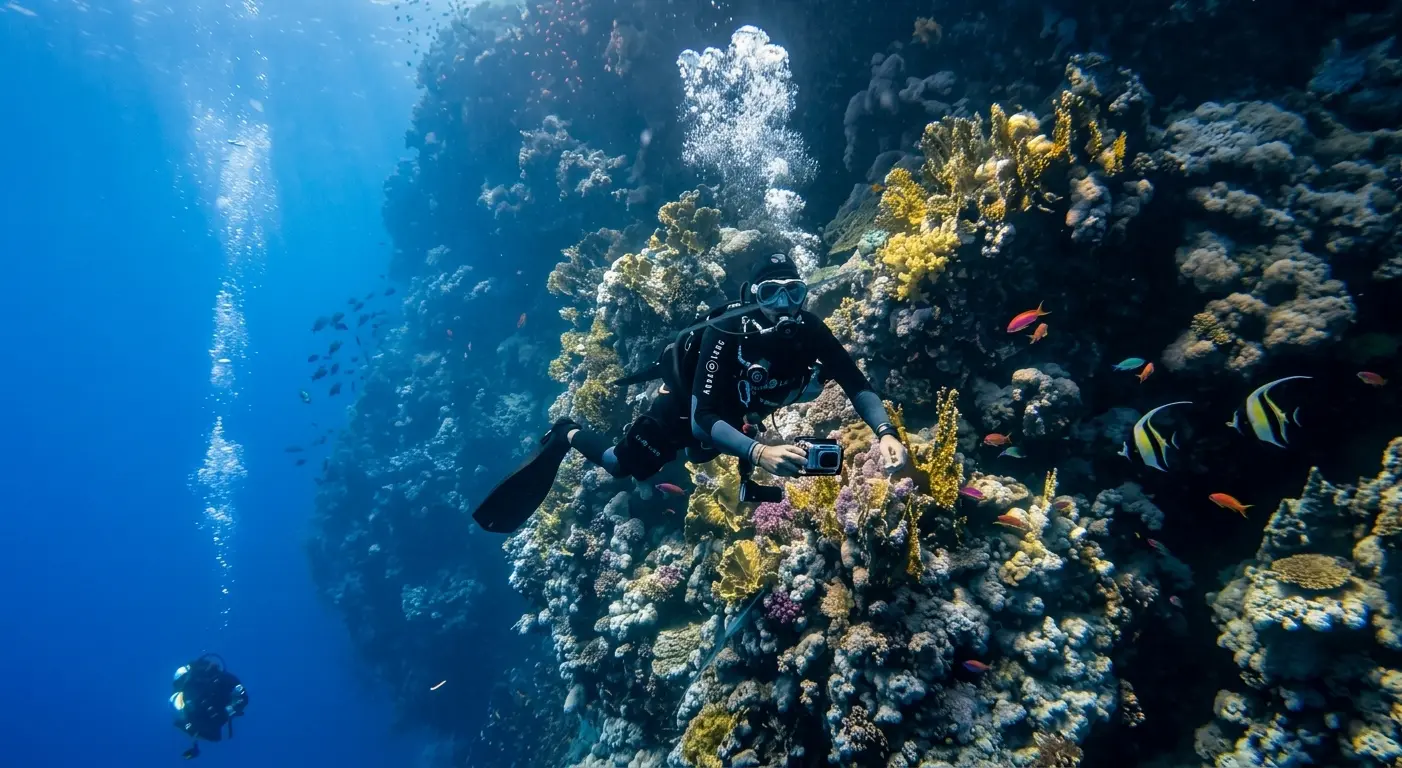
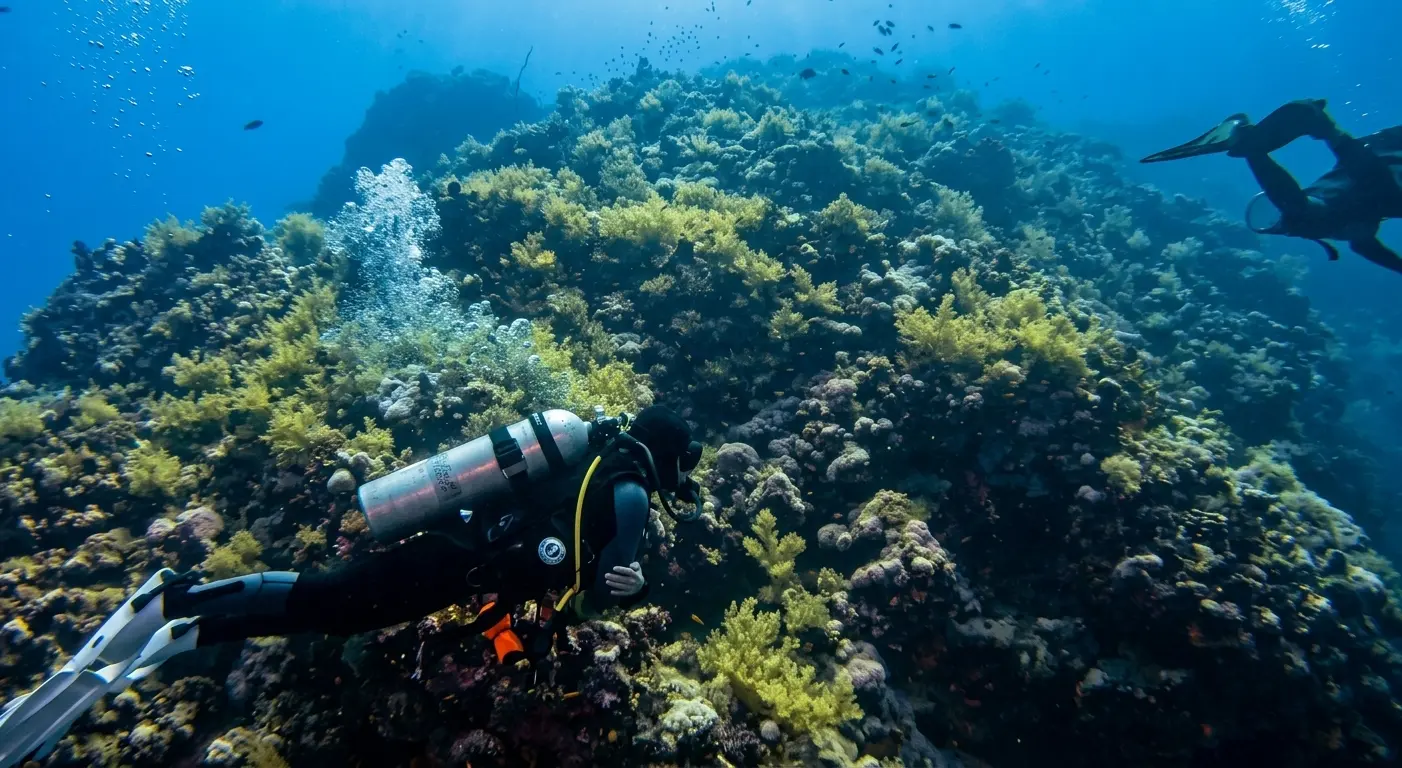
Gorgonian sea fans, black coral bushes and dense soft coral cover almost every surface. Because the reefs here have escaped the diver pressure that damaged parts of the northern Red Sea, the coral on and around the Numidia Wreck remains genuinely exceptional. Visibility averages around 20 m and often far better.
When to Dive the Numidia Wreck: Season Guide
| Season | Water temp | Conditions | Highlights |
|---|---|---|---|
| March–May | 23–26 °C | Improving, still breezy | Hammerheads, threshers; classic Brothers season opens |
| June–August | 27–30 °C | Calmest seas, best visibility | Longest days, up to five dives daily, warm-water comfort |
| September–November | 26–28 °C | Excellent, peak liveaboard demand | Best all-round balance; oceanics arriving late in the window |
| December–February | 21–24 °C | Roughest; trips can be cancelled or rerouted | Peak oceanic whitetip and hammerhead activity for those who accept the risk |
Photographing the Numidia Wreck
- Go wide. Fisheye or 16–35 mm equivalent. Nothing else conveys the incline.
- Shoot afternoon. The north wall gets its light late; morning dives are moody, afternoon dives are colourful.
- Use the diver. Scale is the whole story — a model on the mast or in the davits sells the image.
- Ambient over strobe for the big hull shots; strobes for the train wheels and anemones.
- Never chase. Sharks come to you at the Brothers. Divers who chase, lose — and get deep doing it.
How the Numidia Wreck Compares to Other Red Sea Wrecks
| Wreck | Depth | Difficulty | Defining feature |
|---|---|---|---|
| Numidia Wreck | 8–80 m+ | Advanced to technical | Vertical wall wreck, coral cover, sharks, train wheels |
| SS Thistlegorm | 16–32 m | Advanced | WWII cargo: trucks, motorcycles, locomotives |
| Aida | 30–65 m | Advanced to technical | Second Big Brother wreck, ~100 m from the Numidia |
| Rosalie Moller | 17–50 m | Advanced | Intact, atmospheric, glassfish-filled |
| Salem Express | 10–30 m | Advanced | Modern ferry; a memorial site, dived with restraint |
| Giannis D | 5–27 m | Open Water+ | Disorienting angles, easy access at Abu Nuhas |
The Thistlegorm has better cargo. The Giannis D is easier. Nothing else in Egypt combines a century-old steamer, a vertical wall, world-class coral and pelagic sharks in one 45-minute dive.
Beyond the Wreck: Everything Else at Big Brother Island
The Aida
Roughly 100 metres from the Numidia lies the Aida, a 1,428-ton supply vessel that struck the island’s rocky shore in heavy seas on 15 September 1957 while delivering lighthouse personnel. She sits from around 30 m to beyond 60 m and is normally dived as a separate profile.
The Lighthouse
The stone lighthouse, completed in 1883 by the British and standing roughly 30 metres tall, is the reason Captain Craig had a light to sight — and the cruel irony of the whole story. Its walls are around four feet thick at the base. Its original Chance Brothers gas mechanism served for more than a century before electrification in 1984. The Egyptian Navy operates it today, and a small garrison lives on the island. Jacques Cousteau visited; so, in the early 1960s, did President Gamal Abdel Nasser, who stopped for tea with the keepers.
The Plateau and the Reef
Big Brother’s southern plateau and its sheer walls are dives in their own right, and Little Brother — a kilometre south — is where threshers and hammerheads perform. Most itineraries budget two to three dives on Big Brother and two or three on Little Brother, permits and navy scheduling allowing.
Conservation, Permits and Marine Park Rules
- The Brothers have been protected since Egypt’s 1983 marine reserve declarations. Access requires permits held by licensed vessels.
- Night diving is prohibited — down-current and open-ocean drift risk.
- Vessel numbers and mooring time are controlled; the navy sometimes permits one day, sometimes two.
- No gloves, no knives, no touching, no taking. The Numidia is a protected archaeological and ecological asset.
- Buoyancy is a conservation tool. A fin kick into a 40-year-old gorgonian undoes decades in one second.
Planning Your Trip to the Numidia Wreck
Getting There
Fly to Marsa Alam (RMF) or Hurghada (HRG); most Brothers liveaboards depart from Port Ghalib or Hurghada. Itineraries are typically 7 nights, commonly branded “Brothers, Daedalus and Elphinstone” or “Simply the Best.”
What to Pack
- Personal DSMB and reel — treat as mandatory
- Dive computer (a backup is wise on a wreck this deep)
- 3 mm summer / 5 mm winter wetsuit; hood in winter
- Torch for coral colour and hold interiors
- Certification cards and a genuine logbook — crews do check
- Nitrox card if you have one; if you don’t, get one before you come
Managing Expectations
Weather can shut the Brothers down entirely. Every honest operator says so, and every itinerary carries alternates. Book with that written into your expectations, not just into the terms and conditions.
Frequently Asked Questions About the Numidia Wreck
How deep is the Numidia Wreck?
The wreck spans from roughly 8 metres at the shallow bow debris and train wheels down to about 80 metres at the stern, rudder and propeller. Recreational divers typically work between 8 and 40 metres. The deepest sections require technical training, mixed gas and decompression planning.
Can beginners dive the Numidia Wreck?
Not realistically. Most operators require Advanced Open Water or equivalent plus around 50 logged dives, and enforce it at check-in. Newly qualified divers with limited current experience should build up on easier Red Sea sites first — the Brothers punish inexperience with strong currents and a wall that drops into the abyss.
Why did the Numidia sink?
Human error. On 20 July 1901 the ship ran onto Big Brother Island’s reef at around 02:00 after Second Mate James Tulloch made an insufficient course alteration, failed to inform Captain Craig, and most likely fell asleep on watch. The Board of Trade suspended Tulloch’s certificate for nine months and criticised Craig for leaving the bridge too early.
What are the famous train wheels on the Numidia Wreck?
They are cast-iron railway wheels bound for the Indian Imperial Railways, lashed on deck when the ship sailed from Liverpool. Two pairs remain at roughly 8 m and 12 m — left behind during the seven-week salvage because they were too heavy and too low-value to recover. Today they are so coral-encrusted that most divers need them pointed out.
Can you dive the Numidia Wreck from Hurghada or Marsa Alam on a day trip?
No. The Brothers Islands sit roughly 60–67 km offshore and are accessible only by liveaboard. No day boat operates to Big Brother Island, and Marine Park permits are issued to licensed liveaboard vessels.
What sharks can you see at the Numidia Wreck?
Grey reef sharks are near-resident. Oceanic whitetips and scalloped hammerheads are most likely from late October through April, when water temperatures drop. Threshers and silkies appear occasionally, and mantas and hawksbill turtles round out the big-animal cast.
When is the best time to dive the Numidia Wreck?
June to November offers the calmest seas, warmest water and highest chance the trip actually runs. December to April brings the best shark action but rougher crossings and a real risk of cancelled Brothers days. Many divers consider September–November the ideal compromise.
Is the Numidia Wreck safe to penetrate?
Parts of the holds, gangway, engine room and bridge are reported accessible, and the missing wooden decking means light and exits are plentiful. That said, penetration at 40 m+ inside a 125-year-old hull is a training-dependent, guide-approved decision — never a spontaneous one. Confirm everything at the briefing.
Do you need Nitrox to dive the Numidia?
It isn’t mandatory, but on a wreck this deep and a schedule of four to five dives a day, enriched air meaningfully extends no-decompression limits and reduces fatigue. If you plan a Brothers liveaboard, getting Nitrox certified beforehand is one of the highest-value preparations you can make.
Final Thoughts: Why the Numidia Wreck Belongs on Every Diver’s List
Some wrecks are historically important. Some are beautiful. Some deliver sharks. The Numidia Wreck is the rare site that does all three simultaneously, and it does so in a setting so remote that the reef around it has been spared almost everything humans have done to the northern Red Sea. A 6,399-ton Glaswegian steamer, lost in six months to a sleeping officer, is now a coral-armoured cathedral hanging over an 800-metre void with grey reefs patrolling its flanks.
Earn it. Get the fifty dives, get the Advanced card, get Nitrox, practise your DSMB until it’s boring, and book the liveaboard. Then, when you drop onto that mast at fifty metres with the blue going forever below you and a century of coral above, you will understand why divers who have seen everything still put the Numidia Wreck at the top of the list.